
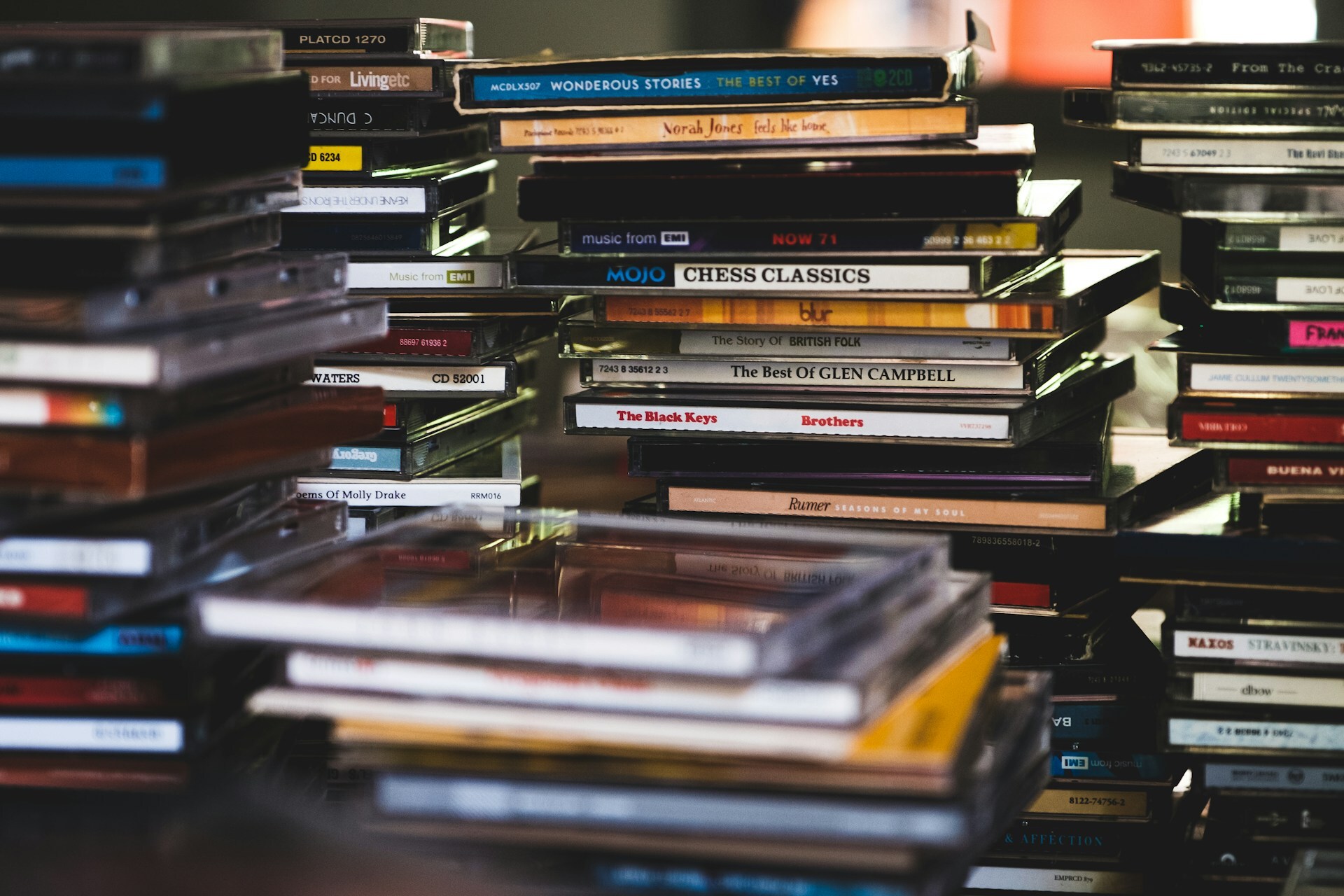
“What’s the first album you bought with your own money?” I love asking people this question because it’s so diagnostic. For one, it gives you an indication of someone’s age without asking outright. But your answer also says a lot about your disposition toward culture. Were you initially drawn to the mainstream or an alternative scene? Do you stand by your purchase, or is it an embarrassing admission?
I feel a tinge of disappointment that I can’t answer the question myself. The first album I have a memory of going to a store to buy was 2000’s No Strings Attached by NSYNC, but I’m positive it was my mom who actually paid. Four years later, when I was both definitely too young and also the perfect age for it, Green Day’s American Idiot became the first album I acquired without my parents’ involvement. It wasn’t on a CD. A friend of mine copied it onto a thumb drive, which I copied to my computer and then to my 256 MB no-brand MP3 player. By the time I musically came of age, the music industry was already in a post-purchasing landscape.
By the late 2000s I had familiarized myself with torrenting, fortunately dodging the Limewire era. That’s how I got my musical education. It’s how I memorized the Beatles catalogue, despite to this day never actually purchasing a Beatles song.1 This was my Pink Floyd phase, my first David Bowie phase, and the start of my ongoing Bob Dylan phase. Eventually I filled up all 80 gigabytes of storage on my computer. When every artist’s catalogue is freely available, why wouldn’t you download the whole discography? I don’t even want to think about how much time I spent organizing MP3 metadata in files on a hard drive long since obliterated.
When I finished high school, Spotify had finally expanded to the United States. I tend to be a few years behind in technology, though. I did not bring a smartphone to college but I did bring my iPod Nano. (Eight whole gigabytes! It even played video!) This time is where most of my CD collection comes from. I associate Random Access Memories with this time, as well as Justin Timberlake’s The 20/20 Experience (Part 1 specifically), Kendrick Lamar’s Good Kid, M.A.A.D City, Arcade Fire’s Reflektor, and the first two installments of Robert Glasper’s Black Radio series.
I can’t tell you the first CD I bought in a store on my own, but I can tell you the last: Singles, by Future Islands, 2014, at the Oaks Mall in Gainesville, FL. I switched full-time to Spotify after that.
Stream On
The post-purchasing era of music has ended. We’re now in the post-ownership era.
My current service of choice is Apple Music. The value is undeniable: on-demand access to what might as well be all of recorded music for less than $12 a month. I probably listen to more music now than ever. I wonder if I enjoy it as much.
Buying an album came with commitment. It was a contract between you and the disc that you were going to listen to it several times. Even if you only bought it for one track, you might as well try to enjoy the other 11. With streaming, even though I can keep up with interesting new releases as soon as they’re out, I’ve noticed I’m far less invested in them. I listened to the new Mitski album. Once. It was alright, I think. I can say “Hey Siri, play some music” anywhere in my home and music will start. It’s so easy to listen to, and so easy to ignore.
Honestly, I still feel confused about how to use Apple Music. If I can add everything to my library, why add anything? What’s the criteria to qualify? What’s the difference between adding to library and adding to favorites, and what would make a song one but not the other?
And what about playlists? They’re collections of songs, of course, but that doesn’t explain their odd behavior. If you add a song to your library (for free) and then remove it later (nothing lost), it also gets deleted from any playlists you added it to. By default, adding a song to a playlist will also add it to your library. You can disable this, but you can’t disable the deletion in the other direction. Sometimes an album’s metadata will break and it gets split into several different albums in your library. Is removing and re-adding to fix it worth having to repair your playlists?
I’m faced with the dilemma that every Apple user encounters: either jump ship to an inferior product, in this case Spotify, or do the mental gymnastics necessary to convince yourself the unintuitive behavior is actually good.
Why the Unintuitive Behavior Is Actually Good
Everyone my age has experience with iTunes – and opinions about iTunes. iTunes, by the end of its life, was so bloated and despised that its death was celebrated. Its death was also exaggerated. It still exists as part of the palimpsest that is Apple Music, hidden and preserved under strata of decaying code and redundant dependencies. That’s why playlists react to changes in your library: Apple Music assumes ownership. The ownership may be free and revocable, but ownership is all iTunes understands. In that context, it makes sense that removing something from your library would remove it from playlists, because your playlists are based on your music. This library-forward philosophy contrasts with Spotify’s playlist-forward structure. You can put anything in a Spotify playlist, because Spotify knows you don’t own it.
I tried to restructure my thinking around this model. Apple Music is a store, and when I find something I like I “purchase” it by adding it to my library. I re-enabled adding playlist songs to library. If I like a song enough to put it in a playlist, it logically follows I like it enough to “buy” it. Right?
I had to break myself of two habits: only buying (or “buying”) albums and never singles, and creating impersonal “every song that appears in _____” playlists. The result has been a library that more accurately and inclusively reflects what I actually enjoy listening to. I just wish the Abba albums would stop splintering.
Digital Love
Clearly, my issue with streaming isn’t the lack of a physical object. We can work with that. Let’s think in terms of budgets. What if, rather than spending $12/month on all the music ever made, I instead spent $10-$20/month on specific music? That’s about the price of an album that doesn’t go away when the ransom money stops. The obvious drawback is it would take years to rebuild a legal digital library, but maybe that’s part of the point. To buy music because you know you want to listen to it.
Thank you to Bandcamp for making purchasing DRM-free music reasonable and cool again. I recently bought some albums from Geese and Spiritual Cramp on Bandcamp and plugged the FLAC files into my Plex server. Not that I’ve listened to them via Plex because why would I, they’re in Apple Music. But I like having them there anyway. The downside to Bandcamp is it’s limited to the Geeses and Spiritual Cramps of the industry. You won’t find any classics or pop hits there.
The more comprehensive source would be the iTunes music store, which is still alive and kicking despite her younger sister taking over the app and getting all the attention. Unfortunately iTunes only delivers files in Apple’s lossy format. I’d be okay with that, considering I’m already in Apple’s ecosystem, if the music store had the same discounts and bundles that made me bulk up my Apple movies library. As far as I can tell, there are never any sales on music. I guess Sony can’t afford it. For full price, I want the maximum quality.
You can still get that.
Touch, I Remember Touch
Vinyl records are more popular than they’ve been since the cassette era. I refuse. I do own a couple records, but only as collectors items. I don’t even own a record player, and the amount of investment and care and upkeep I’ve heard it takes from my vinyl-playing friends turns me off of it. (I recently bought a cassette too, actually, but mainly as a goof.)
They still make CDs, though! If the concern is rebuilding a back catalog, used CDs can be so cheap it’s almost negligible. I visited a used bookstore recently and bought CDs of Gin Blossoms’ New Miserable Experience, the Decemberists’ The King is Dead, and Eve 6’s self-titled (for the meme; it has the Heart in a Blender Song on it!) for less than $15. Bigger names will cost more than that, of course, but not so much to obliterate a $12/month budget. I can easily rip these to FLAC and drop them on my server next to the Bandcamp downloads.
This is a reasonable, actionable plan for building a music collection fully under my control composed of music I like. The next hurdle would be figuring out what music I like. Music streaming’s advantage, arguably its purpose, is discoverability. Algorithmically generated personalized playlists are powerful. I like that I can hear about a band and on a whim load up one of their albums. I like being able to bookmark curated playlists for indie folk, 90s ska-punk, or whatever other specific style I’m in the mood for. I’m willing to become a physical media fiend, but that’s still not a complete replacement. Once again, maybe looking to the past can help.
Radio Is a Sound Salvation
FM radio, as I’ve always known it, is a cacophonic morass of advertisements that sometimes in between plays one of four types of music: gospel, bro-country, latin, or Dad. Yet I’ve always loved the concept of radio, or maybe I’ve just seen American Graffiti so many times that its nostalgic romanticism rubbed off on me. The idea that everyone enclosed alone in their cars are actually being united by something… I miss it the same way I miss linear TV: only in theory, not enough to actually use it. Not unless there was some alternate version of radio with a broader range and no advertisements.
As chance would have it, I bought a new car recently (a 2025 Nissan Kicks, thanks for asking) which meant a few free months of SiriusXM radio. I made heavy use of it both in the car and at work. It’s satisfying to say “today I’m in the mood for 80s new wave” and let the DJ take over. Sometimes you like what plays, sometimes not. You can bail if you want, but you’ll have just as much control over the next station, so maybe stick it out and see what the next song is. Maybe this song will grow on you.
But the trial has ended, and the renewal rate is… $11.99/month. That’s the same price as Apple Music, and we’re back where we started: you can have this radio service or all of the music ever on demand. It’s worth mentioning that Apple Music does have its own live radio, but there are only five channels, operating under vague umbrellas like “Hits” and “Chill.” I greatly prefer the specificity of SiriusXM’s Alt Nation or Soul Town. It’s an open secret that SiriusXM isn’t actually $12/month. Let the subscription lapse and they’ll quickly start offering $5/month for their all-access plan (which includes sports and talk radio, normally $26/month). I’ve held off for now.
Apple Music’s linear radio options may be limited, but they have a deeeeep catalog of curated playlists. “90s Alternative Essentials” is a decent substitute for Lithium, “Breaking Alternative” for Alt Nation, “Negative Space” gets me what I wanted from Faction Punk (RIP). They can even get more granular than SiriusXM can, with playlists like “In the City” for Japanese grooves. I put a few of these on speed dial in CarPlay. Setting them to shuffle is close enough to radio, and most likely that’s what Sirius is doing anyway. But it still feels like a substitute. Something’s missing, and it’s probably something that’s gone for good.
But You Can Never Leave
As I see them, the options that work for me break down as follows:
- Option 1: Set aside about $15/month for buying albums that interest me, ripping them to my private server, and another $5/month for satellite radio for discovery. $20/month.
- Option 2: Buy albums as in option 1, but calcify my taste and never discover anything new. $15/month plus a lifetime of disappointment.
- Option 3: Keep using Apple Music. $12/month.
I’ll be honest, Option 2 is looking more appealing than it should be, thanks in part to generative AI. But I’m still too young to live like that.
Ultimately, the value per dollar of streaming music outweighs the alternatives for my use.2 The best thing I can do, I think, is to not let it dictate my listening habits too much. Listen with intention. Reach for the library tab instead of the algorithm tab more often. Give the art the respect it deserves. Streaming is a powerful tool for discovering songs you like, but liking a song should mean you want to listen to it again. And again, and again.
