
I am a sheep. It makes things easier.
When you travel by plane frequently, you get used to being treated like sheep. Humans aren’t that much smarter. It’s a similar set of skills to manage a herd of humans and a herd of sheep, the difference being humans can read, and many airports don’t even assume that. Airport, I offload my mental energy to you. Tell me where to stand and I will stand. Get me on the plane. Fly me where I’m going. I’ll figure out the rest later.
So when the trip begins with a two-hour delay on the tarmac, what is there to do? You can be like my neighbor, who immediately called IcelandAir support and laid into the customer service agent. Or you can be like me and pull up a movie on the in-flight entertainment system while your neighbor makes no progress. This is a system. I am livestock. I loaded Wonka. It finished before we were airborne.
I always knew I’d travel to Norway someday. It’s genetic. I inherited it from all four of my proudly Norwegian grandparents. Well, realistically it’s more the product of our family’s internal folklore. I grew up surrounded by the kitsch collected by the family of expats who honor their homeland without actually missing it. Norwegian flag mugs, “I Love Norway” t-shirts, fjord postcards and the like. I always knew my voyage was inevitable, but always in some undefined future that never seemed to get closer.
By autumn of 2024 that estimate had shifted from “someday” to “now or never.” I was a few years into my first job with a decent salary, which is how long it took to internalize that this trip was more than affordable. Combined with a foreboding that this may be the last time I could travel abroad without feeling guilty about telling locals where I’m from, I bought my plane tickets almost on a whim.
“You know you’re going with him,” my mom had told my dad when I broke the news.
“I can’t. My passport is expired. Both of ours are.”
“Then renew it!”
“That takes weeks. It won’t be done in time.”
I knew that. I planned this. I spent the covid years unemployed living in my parents’ attic. But now I had a salary and paid vacation days. I explained e-sim cards and FaceTime.
“Okay,” my mom finally relented. “You can go.” As if I was asking permission. I let her have that.
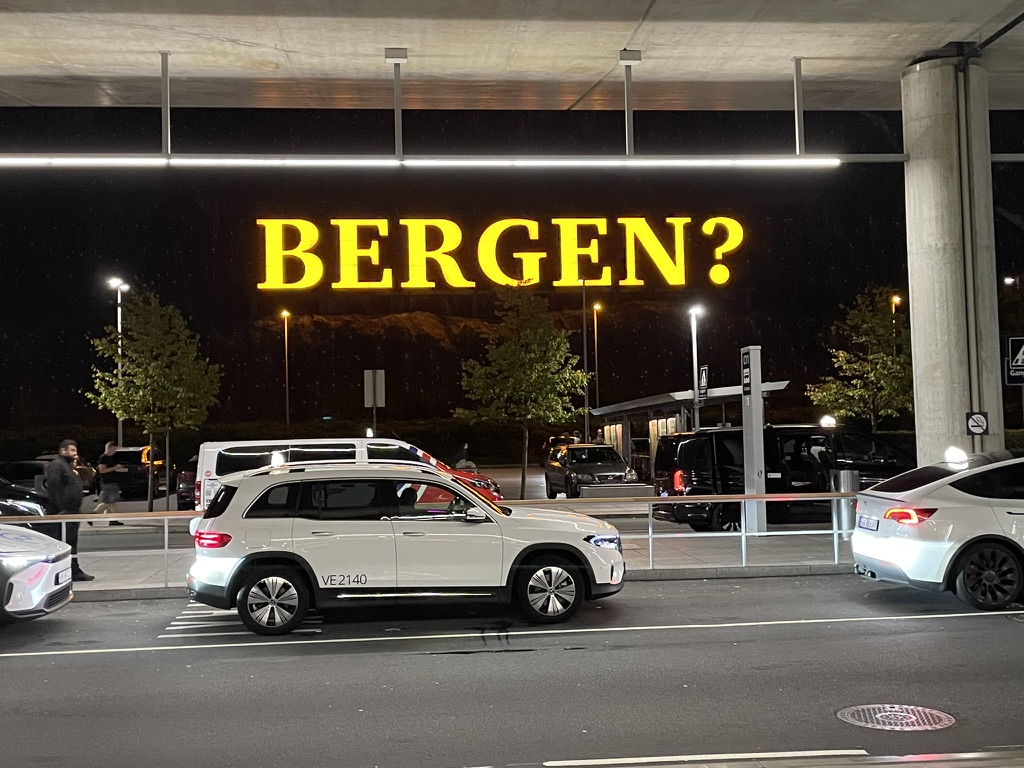
The ticket promised a Saturday arrival. The plane indeed landed Saturday, at 11 PM, almost 12 hours later than anticipated. As I exited the airport, a glowing sign welcomed me to “Bergen?” At this point it had been 24 hours since I boarded my first flight and over 30 hours since I got out of bed, a continuous wakefulness interrupted only by a few hours of sporadic, unpleasant nods over the Atlantic. The question mark felt appropriate.
Bergen is a harbor town surrounded, as much of Norway is, by mountains. In the moonless night I could only infer their outline from the negative space left against the stars. Having lived most of my adult life in swampland, mountains are a novelty to me, but I’d have to take their presence on faith a little while longer.
At the train platform attached to the airport I reunited with my temporary travel companion, a friend I made on the plane. Both Americans, we met during our mutual multi-hour layover in Copenhagen foisted on us by our prior flights’ delays, and coincidentally we sat close enough on the plane that a stranger agreed to swap seats. The travails of travel are lightened when there’s a buddy to commiserate with, over lack of sleep, airlines, and dissatisfaction with our home states. She was from Kansas but spoke with an accent that didn’t betray any particular point of origin. Just American. This was her first time in Norway too, except she was here to visit some friends she met online while I dodged the return question. I never asked her name and she never asked mine. We were both too tired to think to.
We approached a machine at the train station. “Tap your phone here for the ticket,” Kansas explained, stifling a yawn. Norway was a rapid adopter of NFC technology. Paying with cash is almost a novelty. “You can also tap the screen here to switch to English.” She did so.
Slightly let down by the lost opportunity to show off that I can read Norwegian just fine, I opened the Wallet app on my phone and tapped it to the plate. Apparently this was not the place for payment, as nothing happened on either screen, but it did make a chime. I deemed it successful enough and joined Kansas by the tracks.
“Look.” She pointed at the station map. “You’re almost home.” Between Nygård and Kronstad was a station labeled Florida.
“There’s really no escape,” I said. “Do you know where your stop is?”
“My friends are waiting for me here,” she said and pointed at Danmarksplass. “What about you? Do you know where to get off?”
“All the way at the end. Byparken. My hotel is downtown.”
“You know where to go?” She asked without concern, like small talk. Should I be concerned, I thought. I’m only a sleep-deprived foreigner carrying a large backpack alone after midnight.
“I’ll find it,” I said. I had firm trust in my map app and blind trust in Norwegians.
There was standing room only on the train. Kansas and I stood on opposite sides of the aisle and were eventually separated by the crowd, so I decided to test my Norwegian by eavesdropping on a group of students. To my frustration, I couldn’t recognize a word to latch onto. To my relief, I realized they were speaking English. To my dismay, I realized they were speaking English. I needed sleep.
I resumed the cycle of nodding off and jolting awake, my neck feeling weaker each time. The train, too, came to a halt and then jerked forward again. I checked the current stop. Danmarksplass. I whipped my head towards the window and saw Kansas greeting her friends with enviable energy. I hope she enjoyed her trip.
Twenty minutes later, the train relieved its contents at Bergen central station. I let myself be another sheep in a new flock, blending in as well as someone with an oversized travel backpack could. After a block or two the crowd thinned out. It had definitely pushed me towards the city center, so I rode the inertia a little longer before checking my map. The pin for the hotel was exactly two blocks west. I drove toward it with defeated momentum, like a student late for an exam he’s resigned to failing. Finally I spotted the name of the hotel in a window, dark and unlit, and entered.
“Is this the hotel?” I asked the receptionist of the commercial building publicly accessible after midnight. I was cargo. Cargo doesn’t think.
“Yes it is,” she answered mercifully. I presented proof of my reservation. Only six floors above, a bed waited just for me.
“Thank you. The stairs are just over there. Sorry, there’s no elevator.”
IcelandAir having robbed me of a full day in Bergen, I had only that morning to get a sense of the city before boarding my departing train. I decided to leave my things in the hotel and invent a quick tour.
Seeing the city in the light for the first time, I felt surrounded by it, the mountains that hid in the darkness last night now standing large and imposing in every direction but seaward. There are no mountains in Florida. There are barely even hills. In Florida, to be surrounded by a city is to be consumed by it in quantity, knowing that even by car you will not quickly reach the end of it. The Floridian city conquers its environment with pavement. The Norwegian city works with whatever either God or Slartibartfast gave it. In Norway, to be surrounded by a city is to feel it in magnitude, observing you from above. I wondered if the residents of the houses winding up the slopes could do just that and wished I could walk up, knock on the door and ask to see for myself.
Back at sea level, my first task was breakfast. I didn’t quite oversleep the hotel’s breakfast hours, but they seemed to be cleaning up by the time I woke, so instead I went over to a nearby convenience store.
I browsed the aisles, giddily admiring the brand names I didn’t recognize and surprised by the number I did. It felt comforting to know that if I ever moved to Norway my unhealthy relationship with DiGiorno pizzas could continue. I grabbed some sort of packaged sandwich off the shelf that said “frokost”—Norwegian for breakfast—and contained “brunost.” I knew brunost. I had it once as a child and hated it. But it was only fair to Norway to give it another go while I was visiting.
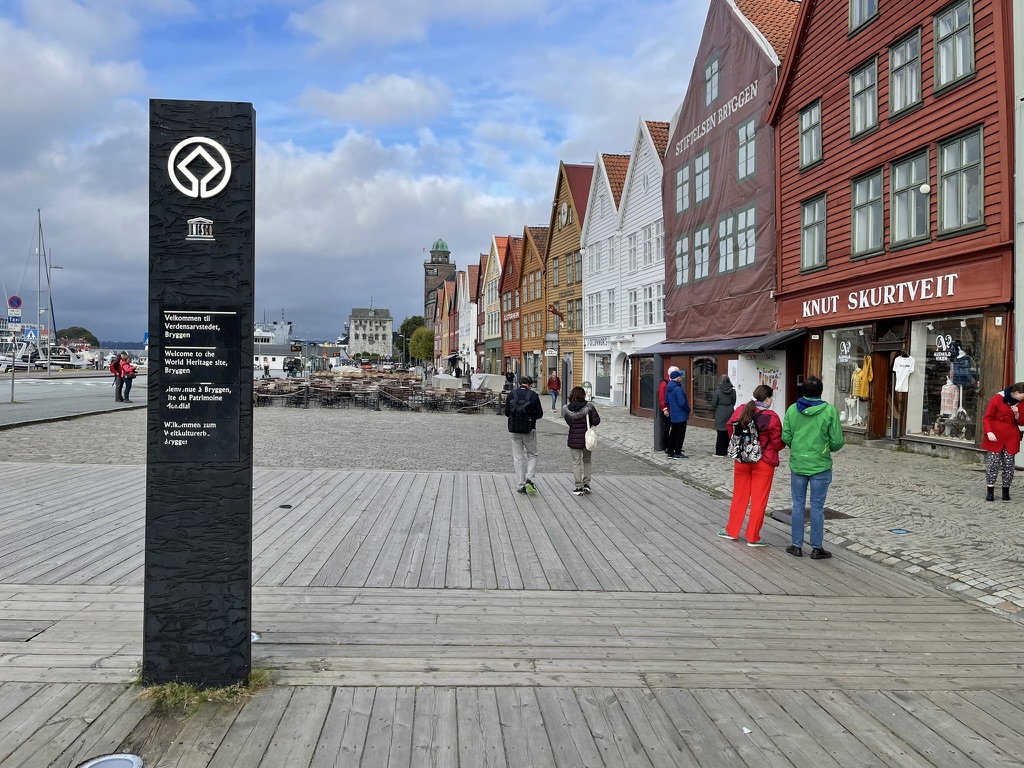
I brought my purchase to a bench by the harbor, just across from Bryggen. A line of historic commercial buildings, the officially designated world heritage site was unsightly, undergoing renovations to stop it from, literally, falling over into the sea. To disguise the work, several buildings were covered by tarps decorated with an image of the building itself. One building housed a Moomin souvenir store, where a group of Asian tourists had formed a queue to take photos with the sign.
A cool breeze rolled in from the sea as I watched the boats at the dock bob up and down. This was a view my dad would have appreciated. A boat pushed off the dock and set out to sea. Fishing, or just pleasure? Probably pleasure, I decided, as I watched it rock over the waves into the overcast distance. The Atlantic Ocean, so blue from the airplane window, was now a deep gray. It was the grandest, widest, flattest obstacle in my journey. Would I have made this trip if I couldn’t fly it? I hoped so. How irritating it would be to never hear this call, never scratch this itch. I took a bite of my sandwich.
No, I realized, I still don’t like brunost.
I took inventory at the hotel:
- Approximately five days’ worth of clothes (I intended to do laundry once or twice)
- Phone and associated accessories
- Two books: a Norwegian-language graded reader and a Lonely Planet travel guide
- A Moleskine notebook and pen, to indulge my fantasies
- The remaining granola bars I had packed as travel snacks
I felt self-conscious about still carrying the graded reader. The language in it was simple and the stories cliché and inconsequential, but I hadn’t finished it yet, so it came halfway around the world with me. I resolved to read the last chapter on the train out of Bergen.
I loved the lightness of carrying my entire existence on my back. It felt safe, like no matter where I ended up that night, on the schedule or not, I would have everything I need. Hopefully it would not soon start to feel like a burden. The September air outside had a chill I associated with the depths of January. I let it slap me awake, drew strength from it, and started back toward the train station.


