The Pilgrimsgården hotel, despite the name, allows visitors arriving for any purpose, though it has a check-in process built entirely on faith. At arrival I found an array of envelopes propped up on the front desk, each bearing a name and containing a key. There was no one to talk to, no presentation of documents or proof of identity. Just a key with my name on it. I took it and shuffled to my room.
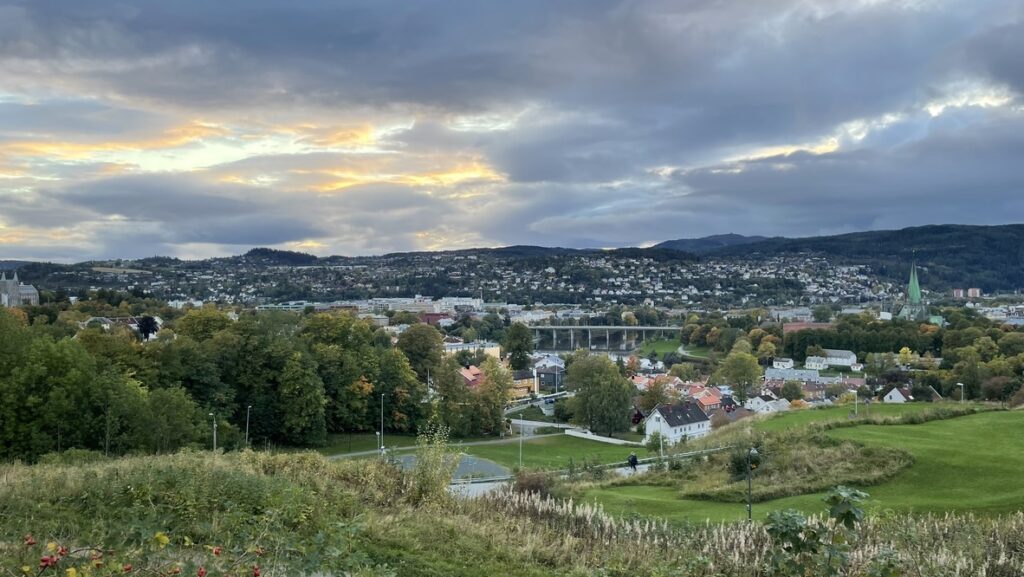
Trondheim, the medieval cultural and religious center of Norway, is the destination city of many pilgrim paths, though how many “pilgrimages” are actually spiritual in purpose I could not say. The most famous trail begins all the way back in Oslo. By collecting proof of visiting churches along the way, a pilgrim can receive a certificate of completion, as well as a discount at the gift shop. I would love to complete that trek myself someday, if I have the time and youth. Somehow I doubt I will.
The room had the simplicity that I suppose a pilgrim would expect. It was white from floor to ceiling, containing only a bed covered in white linens, a white nightstand to its side. There wasn’t even a piece of artwork to provide a splash of color. The only non-essential was a shelf of books, maybe a dozen, half in English and half in Norwegian. I still had the Lonely Planet guide and the graded reader, but decided it would be corny to leave them here. I’d take them to a recycling container the next day.
Across all the days I resided at Pilgrimsgården, I never once saw an employee. Someone must have prepared the keys, someone must have laid out breakfast and turned over the rooms for the next visitors, but they did so invisibly. It was like the hotel maintained itself.
I’m not sure I saw the sun for more than an hour at a time during my stay in Trondheim. Luckily every photo I took of Nidarosdomen seems to have been during that hour, but I can feel the skewed truth in my camera roll.
Each day I stayed, more and more color drained from the sky. What felt to me a sharp, frigid wind at the Nærøyfjord became the new baseline against which true cold was measured.
There’s a popular saying in Norway which I had not been told directly but absorbed anyway: “Ikke dårlig vær, bare dårlige klær.” There is no bad weather, only bad clothing. This is obviously untrue, and I’m sure if I stayed in the country into December and January I could prove it. But in Trondheim I felt the spirit of the expression. Wind pierced the thin, athletic jacket I had worn almost continuously since the Orlando airport as if it weren’t there. On the coldest day I considered ducking into a clothing store and buying a proper down jacket but decided against it. With my only bag still accumulating souvenirs, any new clothes would have to be worn on the plane rides home. I resolved to battle the cold directly during my final days in the near-arctic. The weather was a final reminder that I was not a native here. “Winter will be here soon,” it said, “and you don’t even realize how unprepared you are.”
Like a stubborn child, I took offense but deep down agreed. I love the cold, even now I still love the cold. This was the first time I had seen it angry.
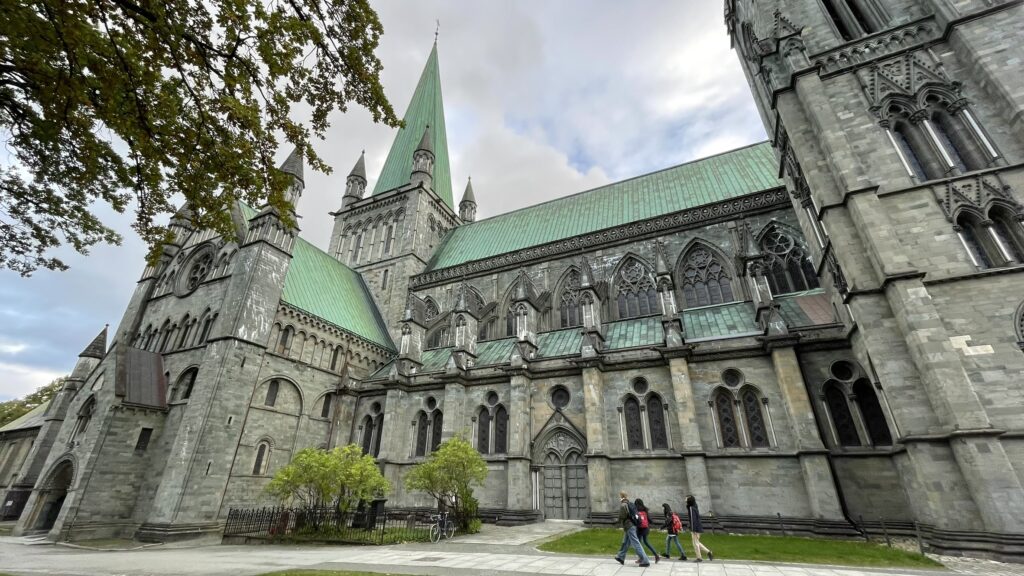
The Nidaros Cathedral dominates Trondheim both physically and symbolically. No matter where I went in Trondheim I could not escape it. It has its own gravity.
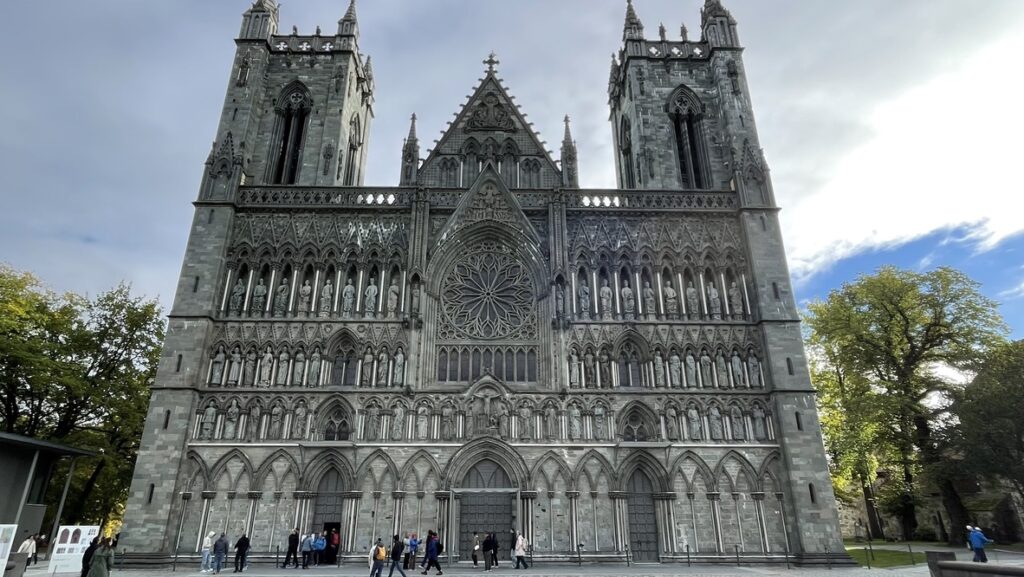
Looking up at the ornately designed west front, I imagined I was Kristin Lavransdatter at the end of her pilgrimage when she donated her golden wreath. But I also felt aware that this view does not cross the centuries into her time. This was not the same cathedral constructed in the 1100s, not really. This cathedral, like so much of Norway, was restored to the point of reinvention during the 1900s and extending to today. Photos of the west front from even the late 1800s are completely unrecognizable compared to the building as it stands now. This statue of Jesus over the entrance is not the same one Kristin would have seen.
So I thought of the craftsmen who devoted their work to the restoration. They devoted much of their lives and their work to this object, this place of national significance, knowing they would never see it completed. The restoration is ongoing.
The interior of the cathedral was even more ornate than the exterior. The stained-glass windows threw kaleidoscopic colors onto the stone walls, drawing the eye upward whenever the sun struck them. Conversation echoed across the stone floors in all directions. This was not the stave church from the outdoor museum, preserved and useless. This building was active. It continued a tradition extending back to Luther and further.
I descended to a cellar exhibiting a collection of gravestones belonging to knights and patrons. Few survived fully intact. I hadn’t before associated churches so strongly with death. Like the church in Voss, entering Nidarosdomen required crossing a wide cemetery.
On ascending again, I noticed a man roughly my age in the southern transept seated on a stool in front of an altar. Head bowed, hands folded, deep in prayer. Maybe he was a pilgrim. I watched him for a short while. He barely so much as twitched.
Next to the altar was a candle station: a box of sand, a tall lit candle, and a basket of short candles, each maybe four inches long. It invited me to light a candle and make a prayer. The wax stubs left by previous visitors poked meekly out of the sand. I looked at the praying man again and decided there was no choice.
I picked a candle from the basket, lit it on the larger candle, and planted it. I closed my eyes and… shoot, what do people pray for? Peace? I started praying that the situation in Israel and Palestine would get worked out, decided “peace in the middle east” was too cliché and at this point probably too big a problem for God anyway, then decided that retracting a prayer for peace in the middle east was actually a worse look. This isn’t going well. Um.
I prayed for something to pray for.
When I opened my eyes my candle was already burnt out. I couldn’t tell which stub was mine.
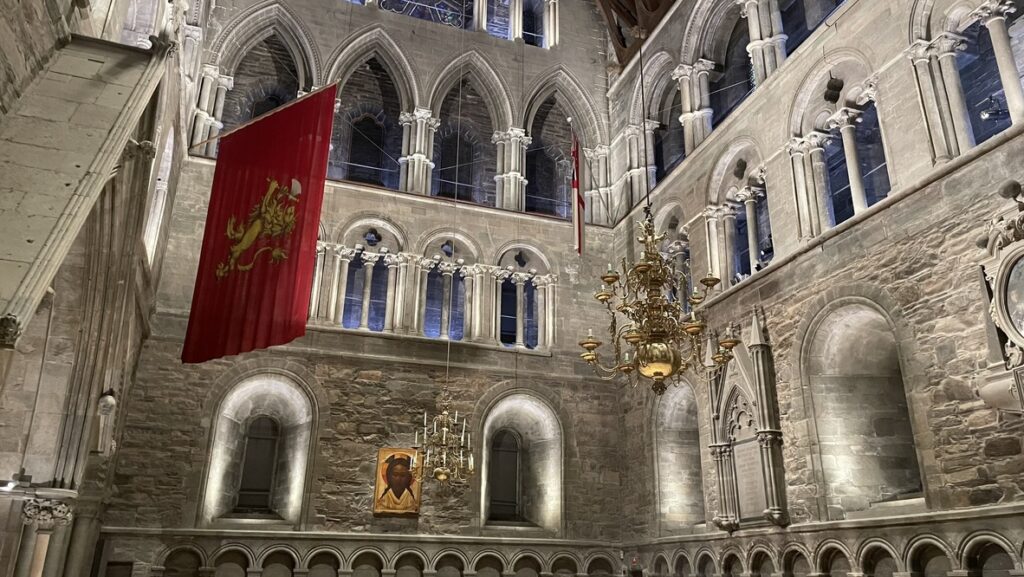
Every Norwegian city I visited felt its age, but Trondheim appeared most proud of it. There were no posters of Quisling here. Even the McDonald’s logos somehow seemed more integrated into the city.
Norway is a patriotic land, especially compared to others in Europe. The hundreds of flags and vimpels (the slender, triangular flags) I saw on the journey here attest to that. I couldn’t help but compare it with American patriotism, which has an uncomfortable ability to feel threatening. I often struggle to see the promise of equality in it. Norwegian patriotism was developed intentionally from a position of subservience, the lesser party in historical unions. It’s softer and for that, I think, stronger. I could never feel threatened by a Norwegian flag.
At a bookstore I amused myself by browsing the Norwegian translations of familiar books. I could understand the international appeal of Et lovet land by Baræck Øbama. Harry Potter og de vises stein reminded me that English is still a skill that must be learned here. And the appropriately bottom-shelf copy of Hillbillyens klagesang made the country feel like a nosy neighbor.
For myself I bought two novels. One was a Jo Nesbø thriller; his work is popular enough in the States that he’s commandeered a full shelf at my local library, though I’m still most familiar with his oeuvre via the comically disastrous film adaptation of The Snowman. The other book I bought blind, not putting in the effort to parse its back cover before whisking it to the checkout counter. I put full trust in its pleasing yellow-and-green cover artwork, the pull quote promising something “mesterlig,” and my future patience.
My final night in Norway deserved some celebration.
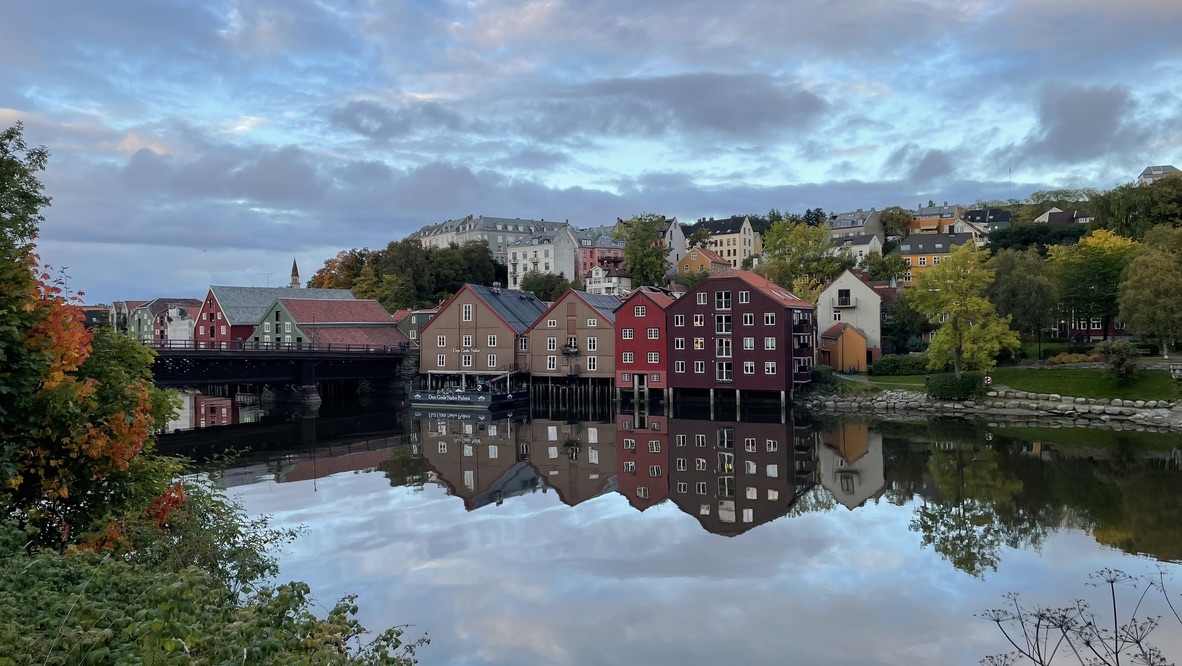
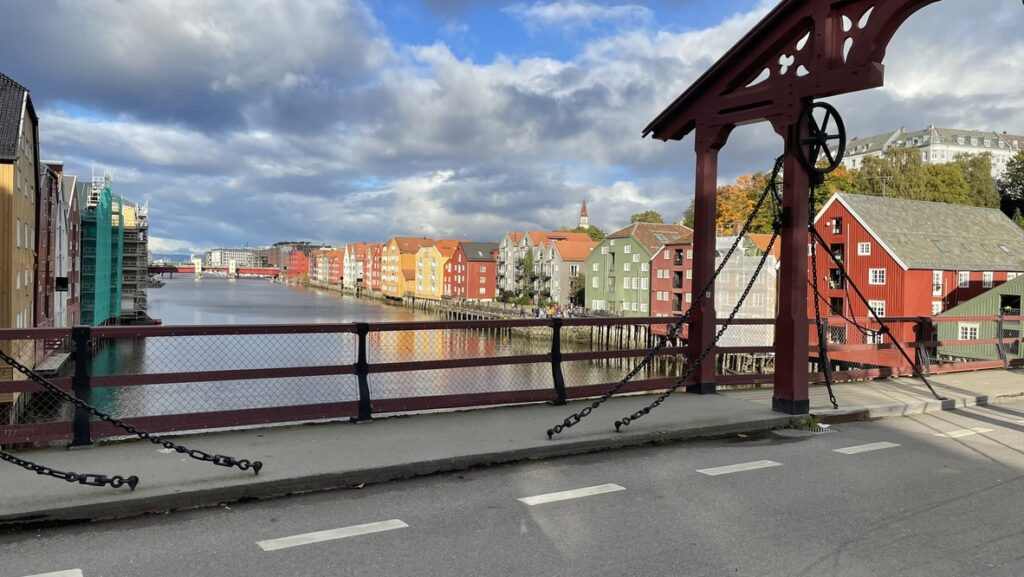
A soft rain sprinkled my head as I made the short walk from my hotel over the historic bridge Gamle Bybro. A staircase led down to a bar tucked away at river level. I hadn’t had any alcohol this entire trip. I’m generally a social drinker only, but this seemed like an appropriate time.
The inside was dim, the lights overhead barely making an impression on the dark wooden walls. A few booths were opposite the bar. Further in there was a second room full of the noise of inebriated Norwegians.
I approached the bar. “Is English okay?” I asked, already knowing the answer.
“Of course.”
“Do you have a local beer?” I don’t drink enough beer to have an opinion on it at all, but I’ve found asking this usually gets an enthusiastic suggestion or two. Besides, I wouldn’t let myself drink Budweiser on the other side of the world. I just wanted a name I didn’t recognize.
The bartender indicated two names on the menu and helpfully explained what differentiates them; I discarded the information and picked one at random.
There was just one more appointment after this. A bus runs once an hour from downtown Trondheim to the airport. I pulled out my phone and confirmed the ticket was downloaded. At 8 AM the next morning, the long journey home would begin.
The bartender returned and handed me a glass full of a crimson liquid. Did I order wine by accident? Fine by me, I guess. I took a seat at the booth instead of venturing into the wall of bodies in the second room.
I mentally took inventory of my backpack, which I managed to pack that afternoon with much more effort than was necessary 12 days ago:
- Approximately four days’ worth of clothes
- Phone and associated accessories
- Three books: two Norwegian-language novels and a Norwegian-language Bible from the museum in Oslo
- A Moleskine notebook with two pages filled
- Many maps and pamphlets
- Ten troll figurines, two shot glasses, three fridge magnets, and a handful of other trinkets for distributing to friends
- A Nidarosdomen snow globe
There was a bowl of crackers on the table. I ate one and then took a sip of the drink. It tasted like a deep, fruity beer. Under the table’s light I noticed it wasn’t red but deep brown with a small head.
“Hey, what is this called again?” I asked the bartender.
“Barleywine.”
I’d never heard of barleywine before. “I like it.”
Sipping the beer, I watched a trickle, and then a stream, of customers enter. The back room started to spill into the booth area, which I took as my cue to leave. For the last time, I stepped out into the frigid Nordic night, ready to become a sheep once again.