
“Rommet er betalt, men vi trenger kortet ditt i tilfelle andre utgifter.”
“Um.”
“Oh, I’m sorry! I just assumed…”
Besides a fair complexion, my genealogy also gifted me an impressively stereotypical name. Think “Bob Smith” translated into Norwegian. Thus the hotel receptionist, after assisting the British family that arrived before me, slipped back into her native tongue as soon as I presented my reservation details. I felt guilty to pull her out of it.
While I felt more than competent in reading and even writing in Norwegian, I had rarely practiced my speaking skills. I’m sure I could have waffled through a conversation in a pinch. Realistically, there is no such possible pinch. Everyone in Norway speaks fluent English. That sounds like an exaggeration but it’s true, up to a certain generation at least. Meanwhile my spoken vocabulary contained few words not used in Kaizers Orchestra lyrics. (Kaizers Orchestra being my primary source of Norwegian as a teenager may have done some damage to my ability to speak it. It’s like learning English from The Proclaimers.) I made the requisite apologies, deposited my backpack in my room, and stepped out into Voss.
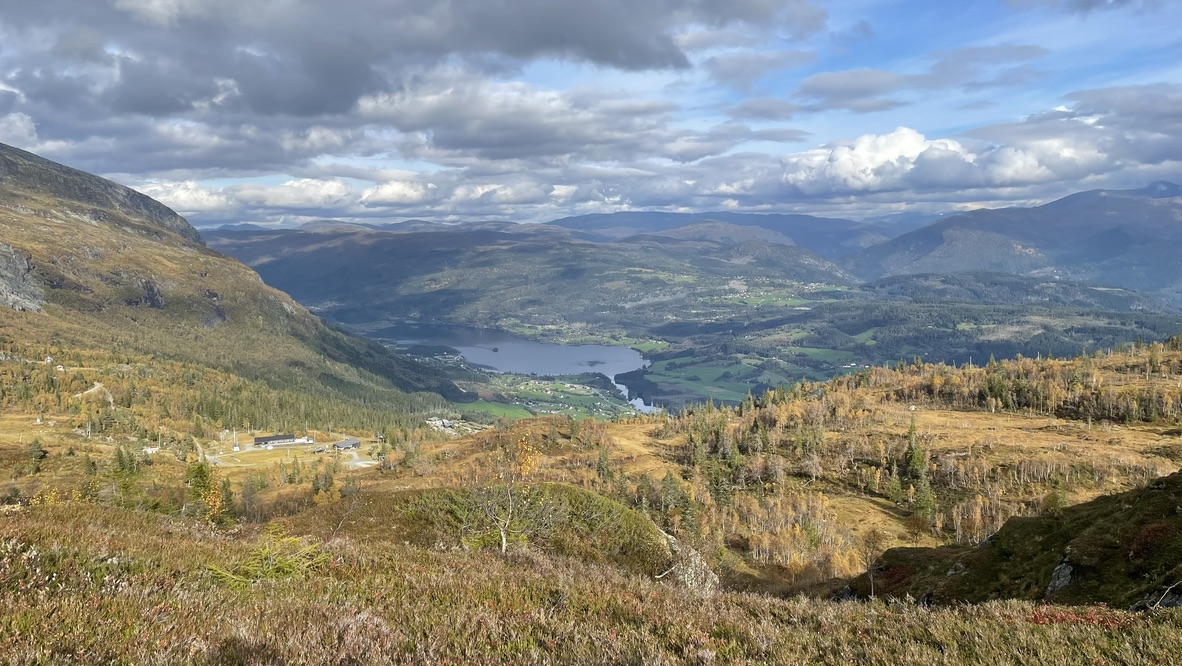
The town of Voss, or Vossevangen, is small enough to walk end to end in under 30 minutes. The west end of town, where the train station and my hotel were situated, hugs the northern edge of the lake Vangsvatnet. Beyond it stand countless mountains, a reminder of the town’s placement in the heart of fjord-scarred Vestland county. These features gave it a reputation within Norway as an extreme sports destination: skydiving and watersports in the summer, skiing in the winter. Its location also made it a hub for international travelers to rest before moving onward to Bergen, the fjords, or other national parks.
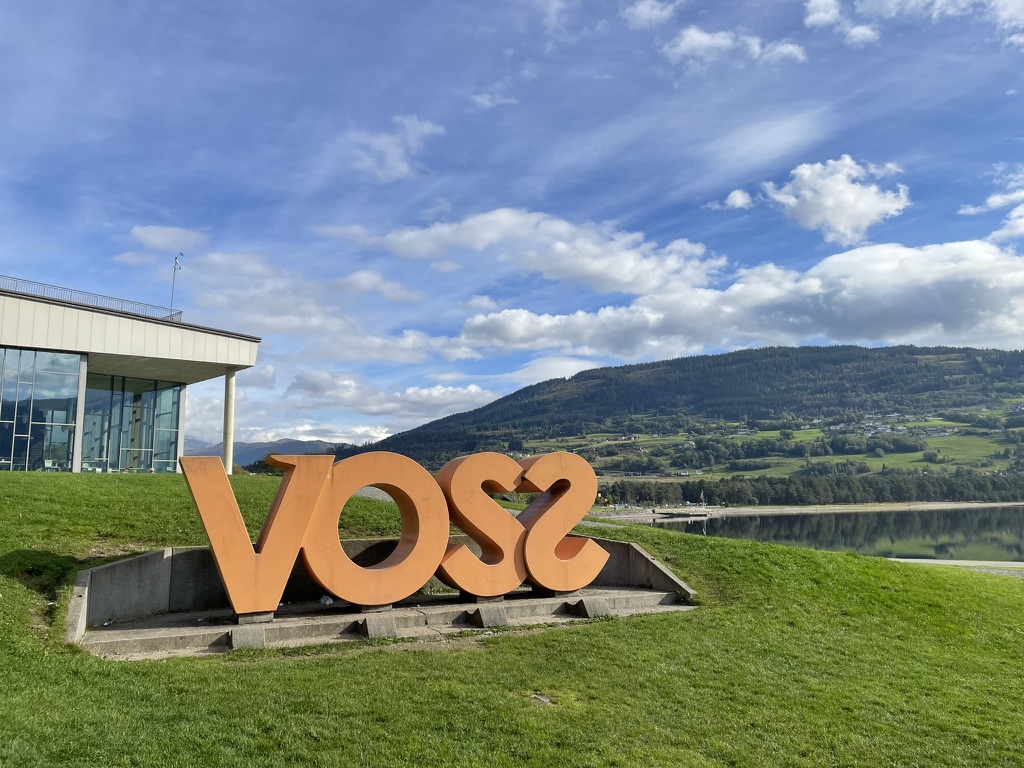
I sat by the lake, on a large green by an all-purpose cultural center. The sun finally shone bright through soft, wispy clouds, turning the unbroken lake water into a mirror that doubled the hills on the other side. It felt different here, the sun. Gentler on the back of my neck.
Suddenly, I wasn’t alone. Another train had arrived and brought with it a few dozen uniformly dressed tourists speaking Mandarin. They all had phones in hand, taking the exact same photos I had taken not ten minutes prior. They didn’t seem to mind me being in their photos, but I did, so I left to explore the town.
Voss itself has little to engage with. Like most Norwegian towns, every store and restaurant closes by 9 PM. My dinner that night would come from the self-service convenience store attached to my hotel. A souvenir store sold ugly troll figurines which I bought to distribute to my coworkers back home.
The only building that carried a sense of history was the Voss Church, located awkwardly behind an intersection clearly not designed with cars in mind. I considered visiting. The church has its own Wikipedia page, after all, so it must be notable in some respect. But every time I passed I saw nobody approach it, and I didn’t want to be the only one to cross the surrounding graveyard. I’m not sure it would have been open anyway. I satisfied myself with some exterior photos, appreciating the architecture as best I could from a respectable distance.
This was Voss. You don’t go to Voss for Voss. You go to Voss for everything around Voss.
The bright green grass darkened to brown as the gondola ascended. Houses stood sparsely on the hills, placed irregularly as if grown from scattered seeds, and shrank into the distance. It was Monday. Tonight the gondola would close until Friday.
Late September is a time of transition in Norway. One by one, businesses shift from summer schedules to winter. Tourist attractions cut hours or close completely. It felt like the entire country was preparing to hibernate. Those with the means to live abroad depart ahead of the oncoming freeze. For the permanent residents, hiking trails become ski trails.
A descending gondola came into view. No one else was in that one, either.
My decision to come in September was strategic. It was right at the tail end of tourist season. Most attractions were still open, potentially at reduced hours, but the visitors who feared the cold were long gone.
And I loved the cold.
I’ve also never truly known cold. Florida has no winter season, only a few weeks of wind chill in January or February. But puppy love is still love. My favorite part of the year is when I need a jacket while walking to work, when it’s possible to toast myself under a heavy blanket. In a way there is no warmth without cold. I was eager to embrace the cold as much as possible.
I was battling the mountain and the mountain was winning.
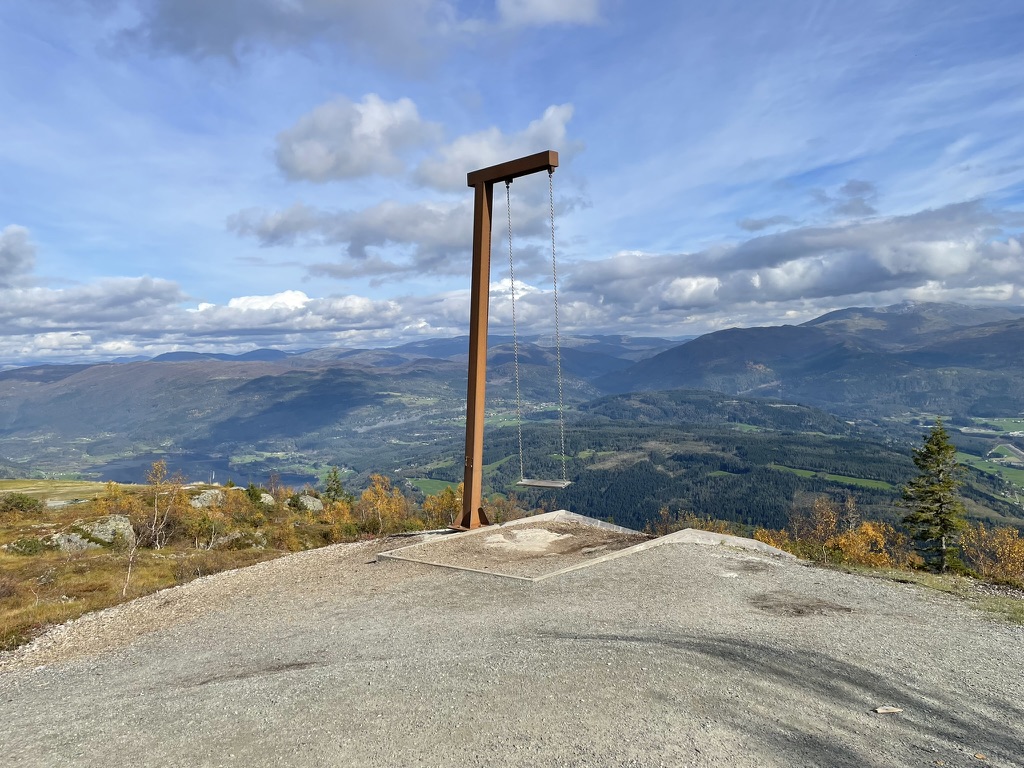
Had I taken on too much? Earlier I followed some simple circular trails around the ski lodge, admired the view from a bench, investigated a precariously placed swingset. With several hours left until sunset, I figured I had time to venture deeper. The paper map indicated a straightforward path from the gondola platform to a cabin near an elevated lake. Just follow the green line. I compared the paper map with my phone GPS.
I was definitely not on the green line.
I closed and opened the map, hoping it would show something different this time. I still wasn’t on the green line. Was I on any line?
I looked around for clues. Every few yards I still spotted rocks marked in paint with a red T, indicating an official trail maintained by the Norwegian Trekking Association. That was reassuring. This was still somewhere people are expected to be. About a kilometer behind me I could see a wooden structure with a truck in front, presumably a first-aid station. Great, I was not in actual danger. Beyond that the gondola station stood stark black against the brown autumnal sedge. The gondola ran until 5:30 PM, but even if I missed that deadline the map indicated three trails that led down to Voss. My penalty for tardiness would be the scenic route back and a severe ache the next day.
“Hei, god aften.”
The voice surprised me even though I had seen her coming. She was maybe 10 years older than me, wearing a long-sleeved athletic top and knee-length pants, poles in each hand. Such a cursory, casual greeting was more than I’ve heard from anyone not being paid to talk to me since Bergen. Even the gondola operator scanned my ticket in silence. Scandinavians have a reputation for being cold towards strangers. In my experience that’s roughly true, but there’s more nuance to it. In Bergen I held a door open for a family who looked at me like I had three heads. But Norwegians also love the outdoors, and taking the same hiking trail is the second best way to get a Norwegian to open up to you. The first is alcohol.
I tried my best to act like someone who hadn’t nearly lost a shoe to a pit of mud and gave a “Hallo” in reply. That was the end of that interaction.
I continued to follow the trail, first to not awkwardly follow the hiker back, then out of pure stubbornness. Mud collected in the cuff of my jeans, encumbering every step of my right leg. My water bottle was nearly empty. I turned it into sweat, which now weighed down my jacket. I made another attempt to correlate my GPS location with the paper map. Still I couldn’t find it. Until I unfolded it further.
I was on a red line. It led up to one of the peaks. I was nearly there. If I reached it, I could at least say I’ve done something here.
The trail crossed a stream that required hopping across some rocks. I did, carefully, wishing I had one of that hiker’s poles. There were no trees up here anymore, only rocks and heather. I scanned every rock near the path for the red T. This was still a trail. I wasn’t lost. I was, in fact, roughly 20 yards away from the peak when the trail became a wall.
I don’t know what else to call a 60 or 70 degree slope of pure stone. It was a wall. And it was the trail. The red lines on the map and the red Ts painted on the boulders led precisely here. It was a jagged, walkable wall. This was the trail’s final challenge. “You’ve done well to get this far,” it said. “This is the last test. Victory is in reach.” My thighs throbbed.
I sat on a rock and looked out over the mountain. Farmland zigzagged to the horizon, small white buildings in clusters like grazing livestock. On the other side, mountains just like this one kissed the clouds.
I was not going to climb this wall. I could have, probably. But whatever I was up here for, it wasn’t on that peak any more than it was right here, watching the shadows of the clouds crawl across the fields.
No matter what, I was going to regret this in the morning anyway.
I finished my water, shook the mud out of my pants, and turned around.
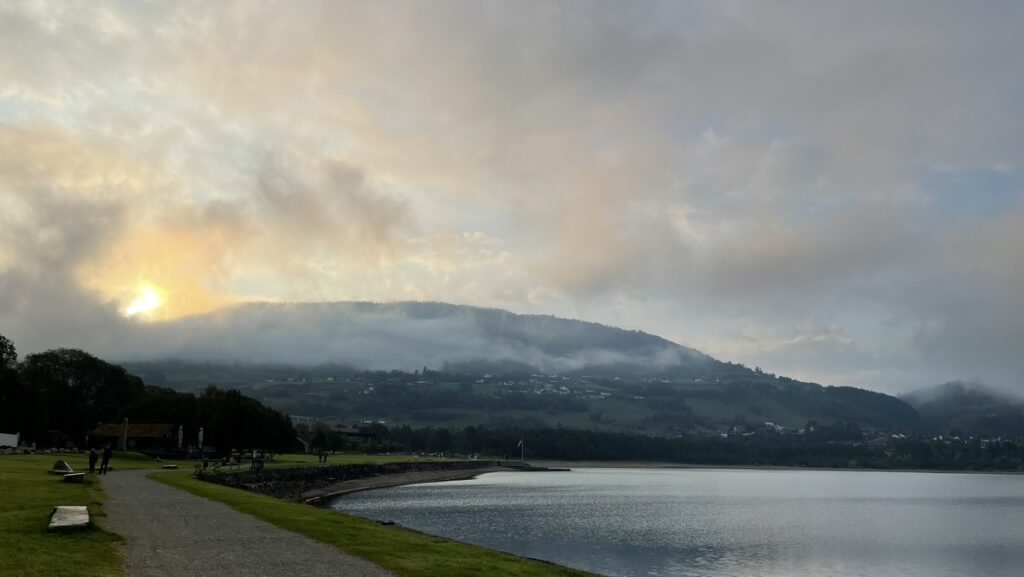
From my hotel window I watched the fog spill over the mountains to the east, fleeing the morning sun for the shadowy lake. The clouds pooled on the surface, mingled in the eddies, lost their identities, found new ones, and drifted southward. I was heading north.
I took one last stroll around town before my bus arrived. The group of Chinese tourists was doing the same, snapping photos of anything that could be reasonably considered a landmark, be it a statue of a nineteenth-century fiddler or a monument commemorating Norwegian contributions to the Napoleonic War. They seemed to have the right idea, so I waited my turn and took the same photos.
I swung by the church again, too. I did want to see the inside, but in the morning haze it seemed even more unapproachable, the graves forming a more impenetrable barrier. Again I saw no one else visit it and left.
I wandered the same blocks I crossed when I arrived here less than 24 hours ago. I passed the same cafes, the same compact grocery stores, the restaurants I was too late to eat at last night. One advertised “American-style pizza.” A tourist hub, indeed. I had a sense I wasn’t seeing the “real” Voss. The real Voss was on the residential streets winding up the hills. The real Voss required a car.
Eventually the town stirred as the sun broke over the mountains and chased the fog away. I made my way to the bus stop, at the same structure as the train station. Workers for the transportation company shouted instructions in English, which the Chinese tour guides translated into Mandarin, which no one listened to. I stood at the front of the line. I’ve gotten good at standing in line these last few days, and I wanted a window seat.
A train arrived, and I saw a young couple exit the station, one of whom was wearing a Kaizers Orchestra t-shirt. For as much as I associated that band with Norway, this was the first I had seen of them. Maybe I’ll find some merch in Oslo, I thought. Was a couple arriving in Voss on a September Tuesday at 10 AM more likely to be natives or tourists? I might have asked them if our departure was five minutes later. The bus door opened. I stowed my backpack on the upper rack and sat by the window.


