

An old joke: If you’re going into the woods in Europe, pack a lunch. If you’re going into the woods in America, pack a gun.
As part of my pre-trip preparation, following the advice of the Lonely Planet guide still in my backpack, I read (a translation of) the novel Doppler by Erlend Loe. In the novel, Doppler, a typical Osloite, abruptly abandons his job and family to move into a tent in the woods, where he complains to a moose about consumerism and the like. It’s a fantasy—who among us hasn’t entertained it? Yet the specific practice of Doppler’s social severance struck me as distinctly Norwegian. He still keeps in regular contact with his wife and even interferes in a popular television show. Moving into the woods not only did not cut him off from society, it did the exact opposite.
The stereotypical Norwegian loves the outdoors. They were born with skis on their feet, so they say, and hike when there’s no snow. In Voss I appreciated the why. In Lillehammer I learned the how.
Intending to visit the ski jump famous from the 1994 Winter Olympics, I asked Apple Maps to chart a course. Despite its reputation, I’ve never had a problem with Apple Maps. In fact I’ve found some of its driving instructions better than the competitors.
It drew a somewhat convoluted path up through the residential area of town. Admittedly I was starting from an odd point and the modest bus system had already concluded for the day. I made the steep ascent and quickly found myself in the woods. The transition from suburb to forest happened so quickly and smoothly that I don’t think I could identify a transition point where houses were still in view.
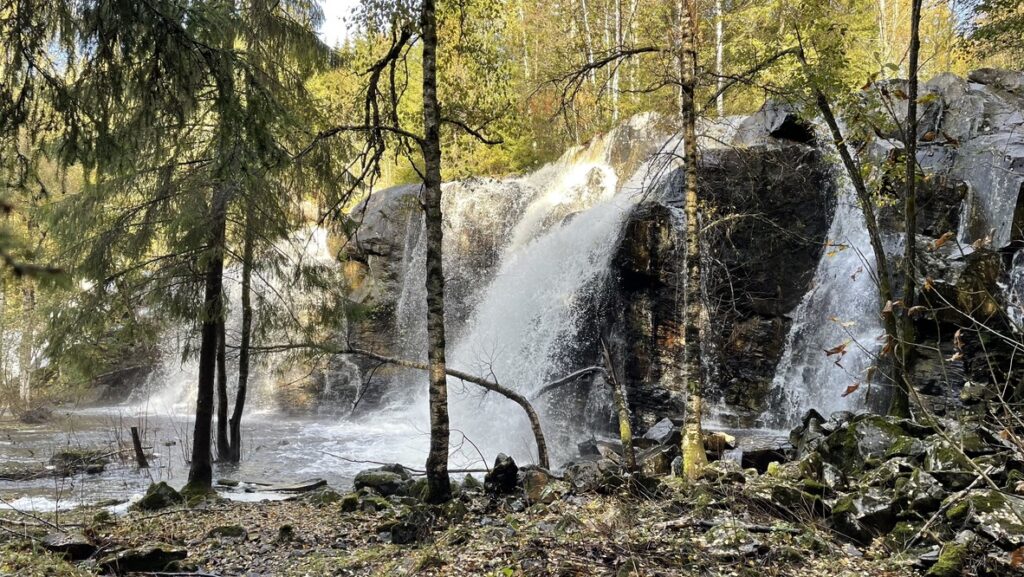
The roar of rushing water led me to a waterfall glowing golden in the afternoon light. A stone at the top formed a natural platform to overlook the rapids. Or was it manmade? The distinction was trivial here. I stood on it and snapped some pictures. From this vantage point I could see the paths twisting through the trees, currently servicing a few groups of people.
I admired the waterfall for a couple minutes before deciding I had to continue to see the ski jump before dusk. I checked Apple Maps again. It told me to jump in.
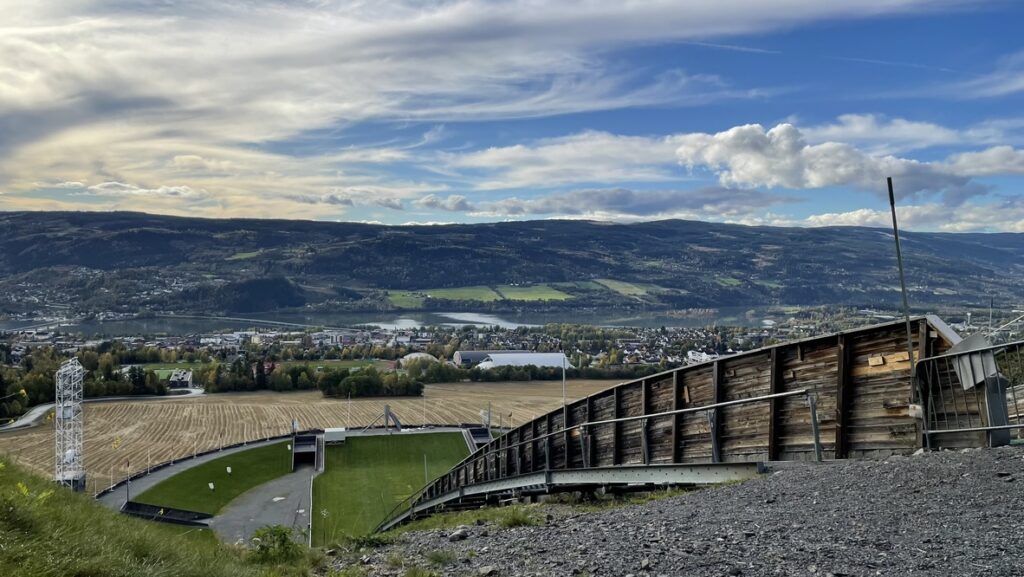
I considered the view from halfway up the ski jump.
Yes, not quite at the top again. I was realistic this time. Conserving energy for the walk back to the hotel was more important than a few more meters of height for photographing the same landscape.
After backtracking through town to avoid Apple Maps’ lethal instructions, the strength in my legs was depleted more than at any point on the trip. I rested on a metal step. They were numbered—I was somewhere between 400 and 500.
The Olympics, unsurprisingly, are a major focus point of Lillehammer’s public image. The five-ring logo is visible just about anywhere in town, from the ski jump if nothing else. The city even houses the official national Olympic museum, where I was presented with a lot of information about the history of skiing and instead focused on the history of Olympic cartoon mascots.
From halfway up the ski jump, it was easy to see why. The town is tiny. If it weren’t for the Olympics, no one would know its name.
Lillehammer is home to one of Norway’s famous stave churches, sort of.
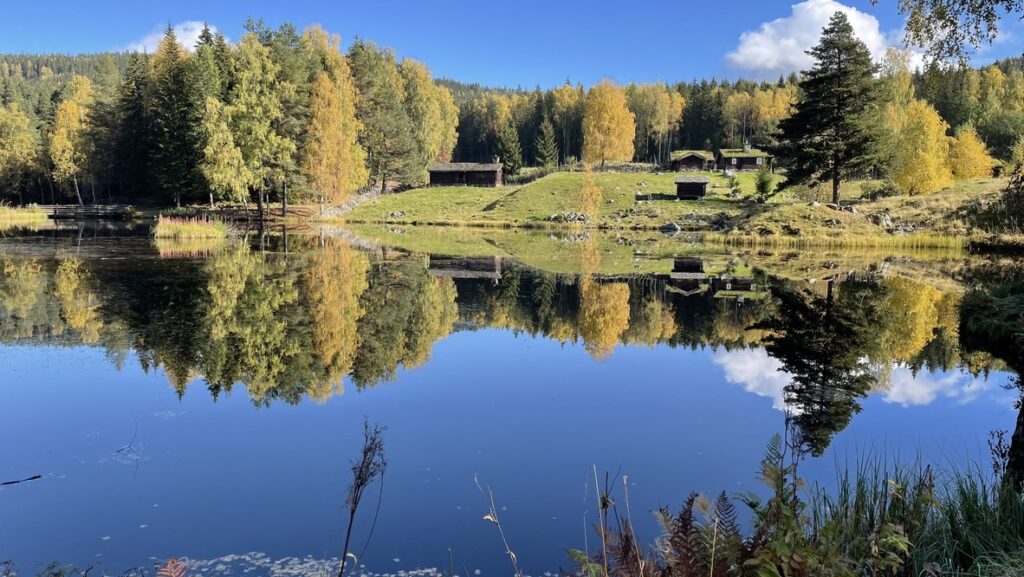
The open-air Maihaugen museum comprises hundreds of historic buildings relocated from across the country and across centuries. It is a city with spatial and temporal sprawl. Sod-roofed single-room medieval dwellings and schoolhouses make neighbors of Queen Sonja’s childhood home. I spent a lot of time in Maihaugen. Besides the historical value, it was simply a stunning space, shining especially strongly under the deep azure, cloudless sky.
The Garmo Stave Church is something of a Stave Church of Theseus. Reconstructed from materials purchased after its demolishing in the late nineteenth century, it’s unclear how much of Garmo’s original material actually remains.
I entered the church cautiously. A wall of warm air stood at the door. I was impressed at how well such old material insulated heat. I guess civilization would not have survived here if they hadn’t figured that out. A group stood in the transept, one person speaking German. I deduced that this was a family and their private tour guide.
Despite the echo of the lecture, or perhaps because I couldn’t understand it, I felt a heavy silence in the space. Every sharp creak of the floorboards as I stepped across the nave rebounded in the pews. I walked softly for fear of awakening the images of the saints lining the perimeter.
The altar stood at the front. On it were a dozen images and dioramas of the life of Jesus, from birth to crucifixion and resurrection. An anachronistic metal chain separated it from me. I appreciated the details from distance as best I could. When the German family had their backs turned, I leaned over the chain as far as I felt I could get away with, keeping my feet firmly behind the barrier the way a trained dog knows that she hasn’t entered a room so long as her hind legs are over the line.
The models were beautiful and clean. They were too clean. This church straddled the line between authenticity and facsimile both in physical form and in spirit. People visit this church to marvel at the concept of the stave church, to consider Norway’s architectural history. Nobody ever came here to worship.
By coincidence more than anything, every hotel room I had stayed in thus far had contained a television. In Voss I did a cursory flip-through of the channels to gawk at the unfamiliar logos and weather maps and otherwise ended my days too exhausted to bother. Here, legs weary in a small town that was shutting down early, I indulged. What was Norwegian television like? The only Norwegian program I ever watched was a sketch comedy show called Kollektivet, which uploaded most of its sketches to YouTube and also ended a decade prior.
I turned on the TV and it loaded into a chess broadcast. TV 2 Sport 2 (that is, the second dedicated sports channel for broadcaster “TV 2”) was airing eight straight hours of chess.
An American cable package is a firehose of hundreds of channels. Even a hotel room will probably provide at least 50. This hotel room had eight channels, half of which were government-run, one of which was exclusively showing chess all day. The other channels seemed to produce mostly quiz and panel shows. I wonder if Europeans get as sick of panel shows as I do of semi-scripted reality shows.
For as indifferent as I am towards television, I am enough of a movie buff to consider a movie theater part of the local experience. Down the street from my hotel was a theater that as far as I can tell was not part of any chain. It may even have been municipally run. It was also the only business open by 9 PM.
Now playing: Quislings siste dager. Quisling’s condescending glare had greeted me at the Lillehammer train station as well. Perhaps if I see it I will stop noticing it, or he’ll stop noticing me.
The theater experience felt mostly similar to the American one. Two teenagers manned a completely ignored concession stand, and a third unenthusiastically scanned tickets. The theater itself was simple, rows of chairs installed directly in the middle of the room. They didn’t come close to filling the space and left wide aisles on all four sides.
The one thing that took me off guard was the subtitles. Despite being a Norwegian-language film screening in Norway, the movie had Norwegian-language subtitles. Apparently it’s standard for all movies to have subtitles. I can’t deny it helped me to follow along but I’m still intensely curious about it. Has it always been like that, or is it a recent change? Is it for the benefit of the deaf? Immigrants? Children? Swedes?
The movie was fine, an unchallenging historical drama that would certainly win some sort of award. I mainly appreciated having an activity that involved only sitting. And I had plenty more sitting ahead. A five-hour train ride, my last, departed in the morning.


