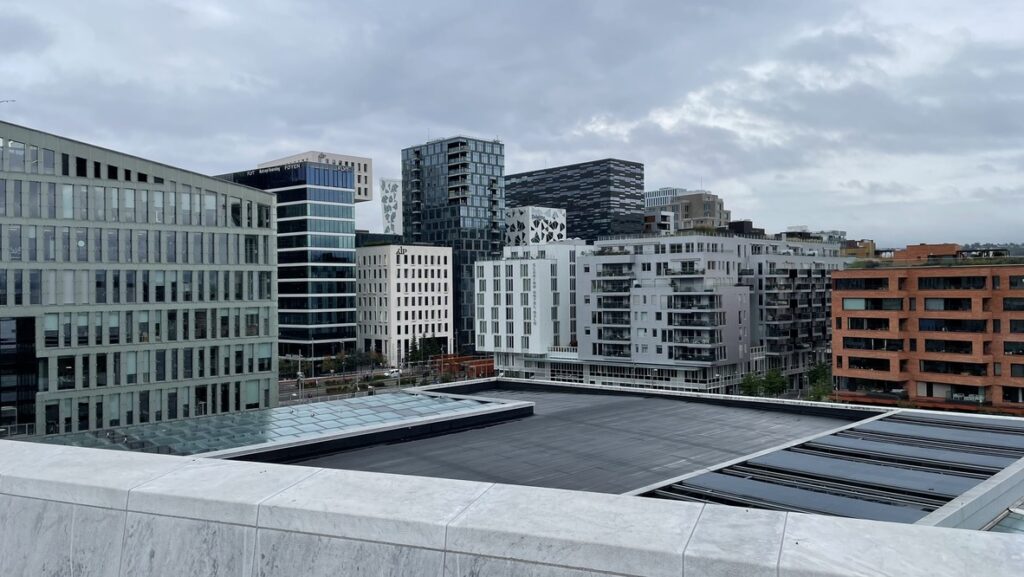
I climbed the rain-slick steps of the Oslo Opera House one at a time. The white marble roof is designed to allow easy access to the top from the exterior. Gazing over the city from the building’s peak, I decided that Oslo and Orlando have one key trait in common: Both are still under construction. It took me two laps around the perimeter of the roof to find a camera angle that omitted the cranes.
I had forced myself to take a recovery day, something I find ironically stressful when I have a limited amount of time in a place. My first day in Oslo, I limited myself to hotel amenities and restaurants in close proximity. With refreshed feet I felt eager once more to explore.
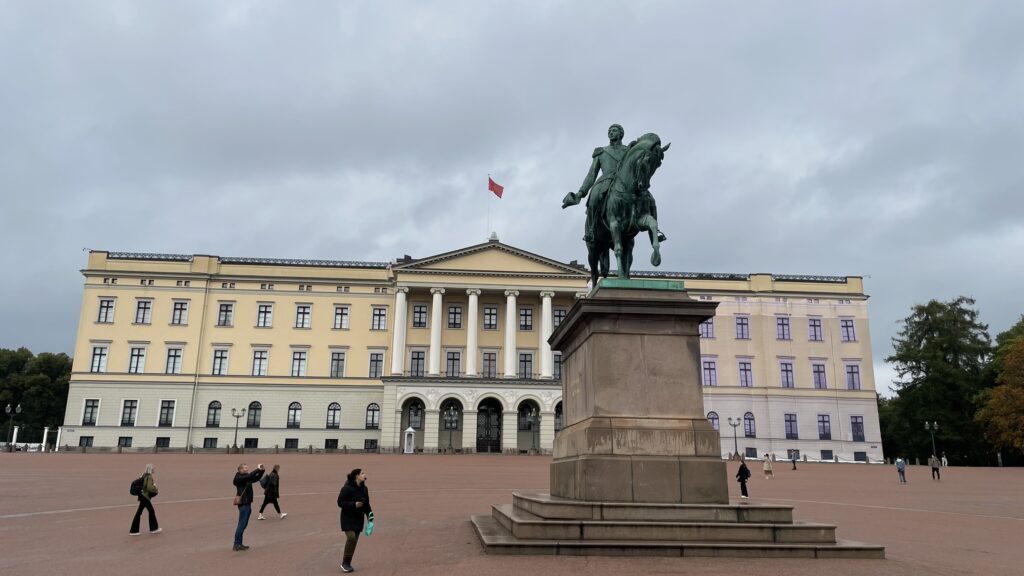
Thus I surveyed the city. The gray of the architecture matched the gray of the sky that colored in the gray water of the harbor. I could see a few of my future destinations, including the Nobel Prize museum and Akershus fortress which my Lonely Planet guide identified as must-see. The King’s Palace, too, was undergoing renovation, half of it covered by a deceptive tarp just as the buildings at Bryggen were. To the east, the letters “MUNCH” on a stylish tall building identified it as the museum dedicated to the country’s favorite homegrown artist. Adjacent to that was the unmistakable “Barcode” district, named for its distinctive black-and-white aesthetic.
Landmarks and museums are nice, but I have much more fun discovering a city on the streets. I looked down at the streets below. Tiny figures entered and exited multicolored buildings. Cars spiraled off roundabouts into twisting alleys. In the distance, multistory commercial buildings gave way to neighborhoods with tree-lined streets. I felt immediately that I could spend an entire year learning the capital. How much could I actually accomplish in a week?
I tackled the museums in two clusters, starting near the central train station. I bought the city’s “Oslo Pass,” which allows access to just about all the museums and public transit for a flat daily fee, and felt determined to get my money’s worth from it.
I started with a cursory visit to MUNCH (Turns out that is the official name of the museum.), dedicated to the life and work of Edvard Munch. There I saw his most famous painting The Scream, or maybe one of the duplicates they rotate it with. I’ll never really know.
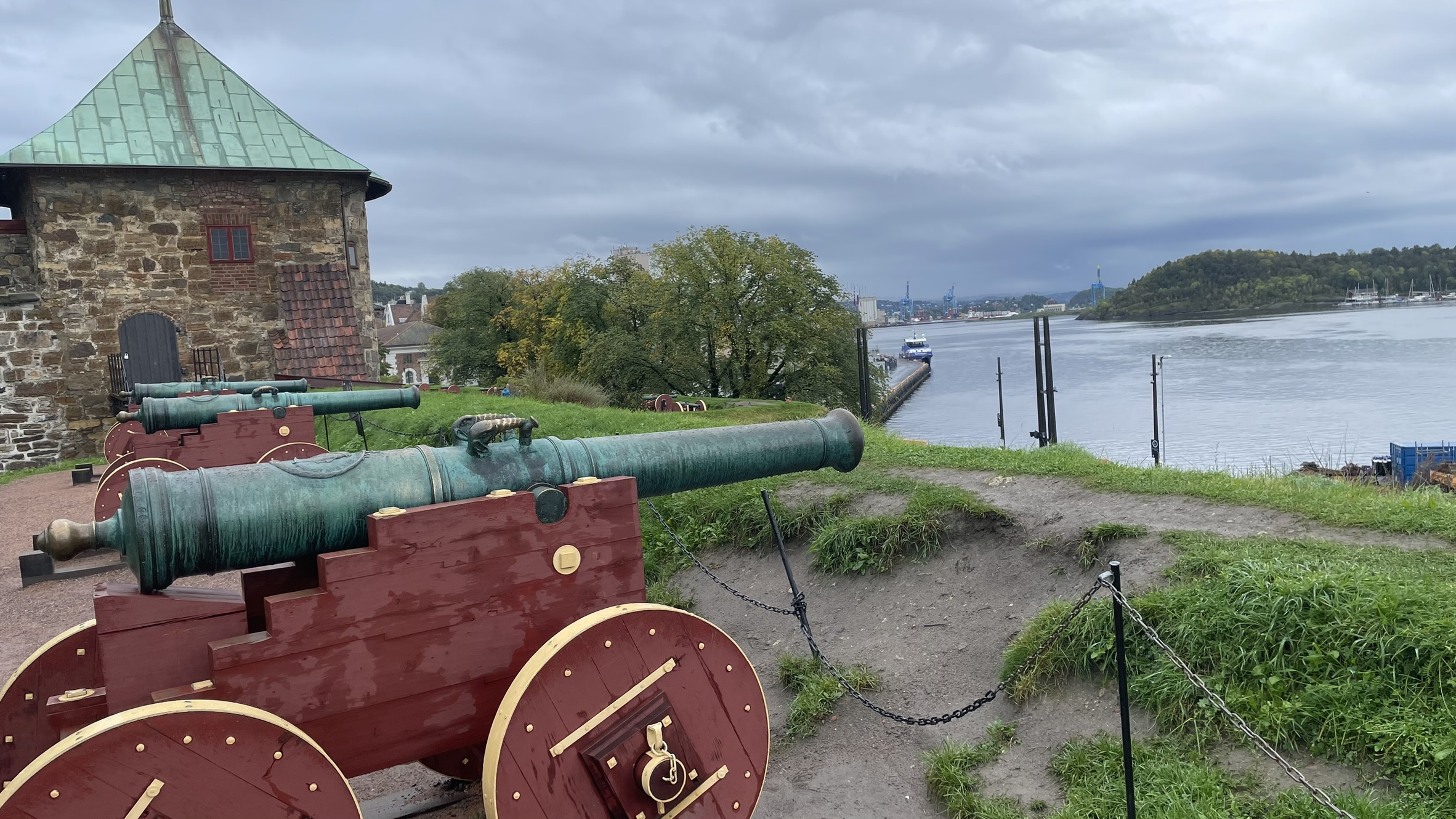
On the west side of the Opera House stood Akershus, the medieval castle. Akershus has a couple museums inside it as well, including the Norwegian Resistance Museum. The museum had exhibits dedicated to the anti-Nazi groups fighting Vidkun Quisling’s puppet government, emphasizing their methods of communication and hiding. The exhibits radiated national pride as well as a hint of desperation. When I told my dad about the museum he quipped, “Norwegian resistance? I didn’t know they had one.” The museum felt constructed solely to counteract that exact conception. By the time I left the museum back into the fortress, the rain had picked up again, forming wide puddles in the broken brick flooring. I took some pictures of cannons and continued westward.
It was around this time I noticed Quisling had followed me outside the Resistance Museum. His face towered above from billboards throughout the city, staring down in contempt. It wasn’t actually Quisling’s face. It was Gard B. Eidsvold, an actor, in advertisements for a movie that had premiered a few weeks earlier: Quislings siste dager.1 I tried to ignore him as best I could.
Closer to the palace were the other two museums of interest to me: the National Museum and the Nobel Peace Prize Museum. I visited the Nobel museum first. The main attraction was an exhibit on the work of Yoko Ono, who, to my knowledge, has not yet won the Nobel Peace Prize. It was nestled in between more conventionally Nobel-themed attractions, such as a display of an actual medal from the early twentieth century and an interactive timeline of winners. I set the screen to display Barack Obama as I left.
The National Museum was full of artwork of all types and mediums, but my main memory of it is feigning deep interest in an eighteenth-century dress as an excuse to sit on the bench next to it. I’m not very good with itineraries.
Oslo is doubtless the world’s most successful entirely cafe-based economy. Expect to find one or two at every intersection, professionals on laptops in the window as advertising, the interior cramming a dozen tables into a room that can only fit ten. My third day in the city I decided I needed to participate, so I entered one arbitrarily—I have no idea how else you’d choose.
“Cafe au lait,” I ordered. I am usually not a coffee drinker at all. The one I bought at the Copenhagen airport out of desperation to stay awake might have been my first of the year.
The barista responded in English. Evidently my pronunciation of this French word was not sufficiently Norwegian. We completed the transaction, and she asked, “Where are you from?”
“United States,” I said. I had been asked this a few times and gotten in the habit of replying “United States” or “USA” instead of “America.” Not that “America” wouldn’t have been understood. In fact, it was the most common reaction: “Ah, America!” But “United States” felt more appropriately international. “Florida,” I appended.
“Cool! I moved here from Canada last year.”
“Oh, where in Canada?” I have a couple of friends in Toronto and was ready to brag to that effect.
“Vancouver.” Sorry, friends. “What brings you to Oslo? Just vacation?”
I peeked behind me to make sure we weren’t holding up a line. This must just be the pace Oslo moves at. “I’m running away from the election ads.”
She laughed politely. I think a Norwegian would have missed that I was joking.
We continued to chat for a spell, me expressing admiration for the country and her apologizing for the weather like a good host, until the coffee was ready. I resisted asking the questions I really wanted to ask: How does a Canadian just up and move to Norway? I’ve long since put out of my mind that emigration was an option for me, though I put in plenty of research before settling on that hard truth. I am simply too incurably American.
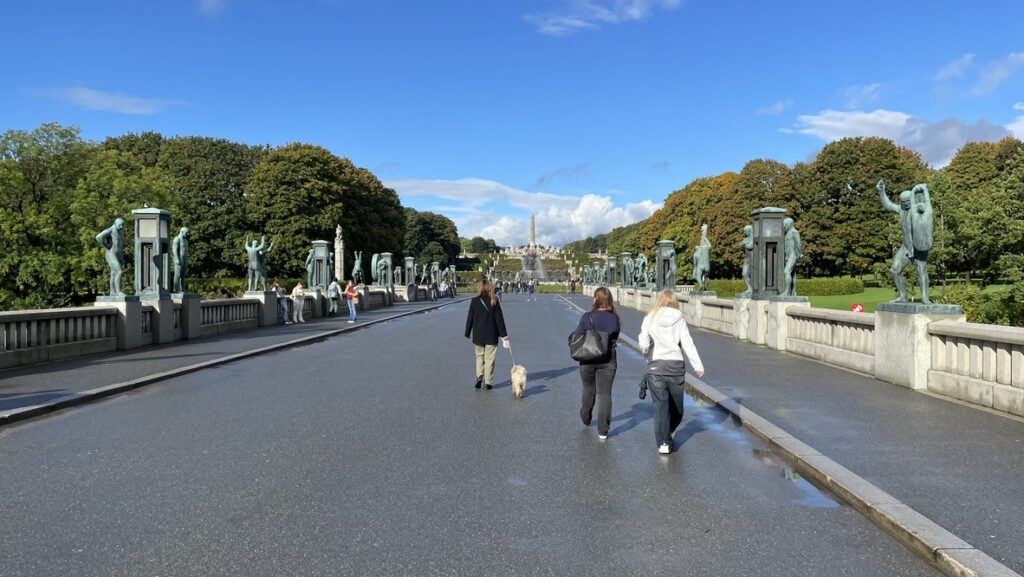
“Frognerparken har mange statuer.” It’s one of Duolingo’s favorite Norwegian sentences: “Frogner Park has a lot of statues.” They should pair it with whatever is the Norwegian word for “understatement.”2
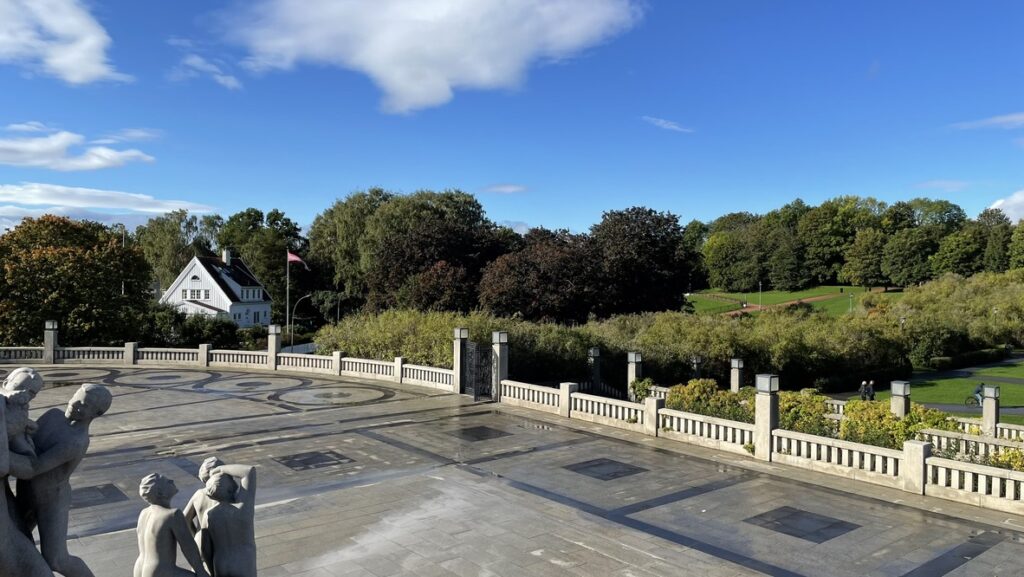
Located a short subway ride from downtown Oslo, Frognerparken is an expanse of green wide enough that standing in the central lawn was enough to make me forget I was in a city of a million inhabitants. The New Yorker in me3 instinctively wants to compare it to Central Park, and I suppose the analogy is fair—adjusted for scale, of course. I took in the view from all sides, the hood of my jacket up to protect my hair from the persistent drizzle. West from my position, a monolith cut 50 feet through the damp air. Lining the paths to the monolith in all directions stood dozens upon dozens of humanoid statues—over 200 total. Each was unique, a plethora of nude figures depicting the entire range of human emotion. Mothers cared for whining children, lovers embraced, warriors wrestled. Some faced the dying rain, others hid their faces in the puddles.
As I approached the monolith I saw it, too, was composed of these figures. Bodies built on bodies like an anthropomorphic Jenga tower. They twisted around each other, an unfeeling collective, their marble muscles grotesquely lifelike in the fresh rainwater.
Beyond the monolith on the west side of the park the sky finally broke and exposed the sun. A breeze shook the heavy, weakened leaves from a nearby grove of trees and they fell at a soft, even rate, as if the sky stopped raining water and instead started raining foliage. I took out my phone and recorded the sight for over a minute. I’m still not sure why. Even in central Florida you can find trees shedding leaves. But somehow, these leaves, in this park, in this autumn, felt more correct.
I left the park at the opposite end from where I entered. On the way out I crossed a bridge spanning a small, racing river and wondered if I had judged the monolith too harshly.
Two blocks from my hotel in central downtown Oslo I found a storefront window labeled “Nordic Bible Museum.” How could I not enter such a delightfully specific exhibition?
A man and woman seated at the reception desk perked up at the movement at the door. No one else was present, and I got the sense I was the day’s first visitor. I was feeling confident today and decided to initiate this interaction in Norwegian.
“Kan jeg bruke Oslo Pass?” I asked.
“Så klart! Skann her, takk,” responded the man. I scanned my app’s barcode as instructed, and he asked how I heard about the museum.
I was honest: “Hotellet mitt er rundt hjørnet.” His face flashed an expression that made me regret it. I had effectively answered “Actually, I haven’t heard of your museum!” But before I could process that thought, the moment was over and he offered me a pamphlet.
“Foretrekker du norsk eller engelsk?”
An escape! I appreciated that he offered in Norwegian. “English, thank you,” I said.
Only the pamphlet was in English. The exhibit labels and explanatory plaques were exclusively in Norwegian. I didn’t mind; Norwegian is an easy language to read. I minded more the guide’s repeated explanation that English translations were available on the website.
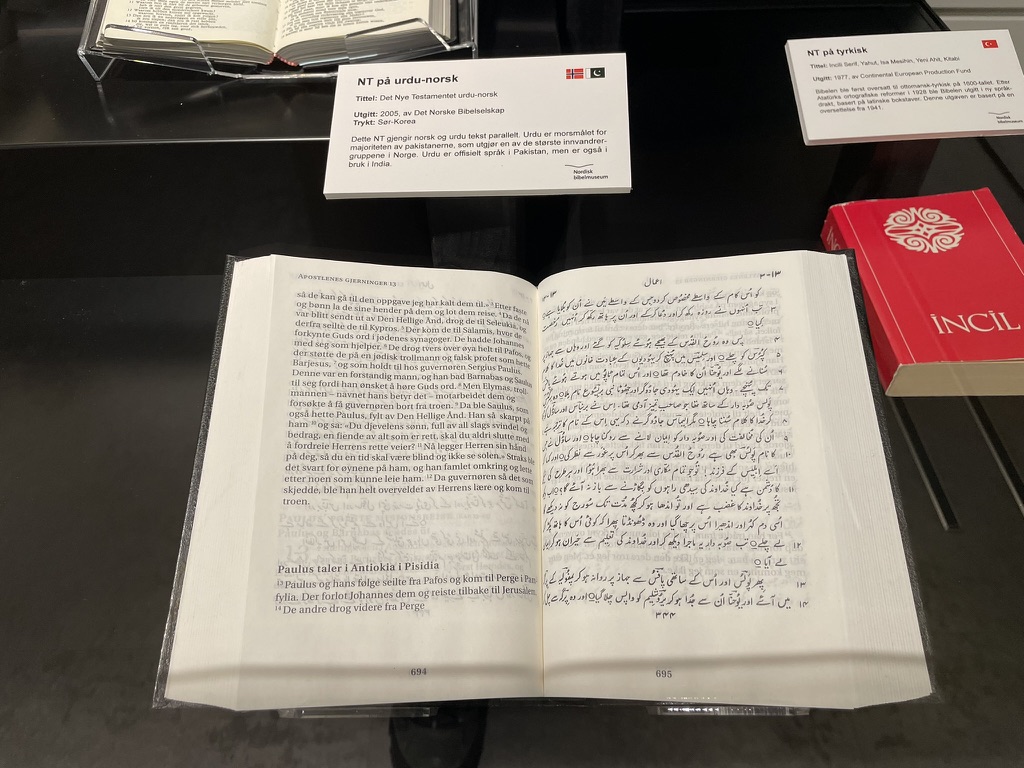
After some additional pleasantries and instructions, I entered the museum proper. Glass cases lined the walls of each of the two rooms, protecting centuries-old Bibles written in various northern European languages. The echo of my footsteps as I circled the displays reminded me of my status as sole patron—and therefore informed the reception desk of my progress. I made sure to slow my pace.
Discovering this museum was a providential coincidence. A few years prior I read the Bible in full, front to back, for the first time. As a student of literature I felt obliged to read the most influential piece of literature ever written and unexpectedly grew to appreciate its literary qualities. Teenaged edgy-atheist me would have scoffed. Shortly before this trip, it became a subject of armchair scholarship for me as I took an interest in its translations and theological differences between them.
The centerpiece of the museum for the history buffs was a page from the Gutenberg Bible, arguably the most important published book in world history. But I’d bet their most popular exhibit is the collection of miniature Bibles. One measures just twelve square centimeters and is only readable with a magnifying glass. For my part, I particularly enjoyed the ornately decorated tomes belonging to the Danish kings. I engaged the man who by this point had become my personal tour guide with some rote questions about translation, mostly to signal to him that the museum was appreciated. I visited the gift shop on the way out.
As my days in Oslo slipped away, I decided I spent too much of my time in the heart of the city center and committed to spending my penultimate day exploring. Oslo has literal layers of public transit stacked on each other. Between the subway, tram, and bus system, you can get just about anywhere with ease.
I hadn’t taken a bus yet, so I hopped on one that would take me to an interesting-looking park north of the city. The bus set off north. Then it stopped, turned around, and headed east. Maybe this is normal, I thought, and I must have looked too relaxed, because the woman in the seat facing me spoke.
“Ruten har endret seg, ja? Vet du hvorfor?”
“Um.”
I meant it as an um of “I need a second to process what you said,” but apparently it came across sufficiently as an “I don’t know why we’re off-route either” um, because an elderly woman nearby chimed in. There was an accident somewhere on the route, she explained. We had to take a detour. It was an extreme detour; I checked the Oslo bus system website and learned this bus was no longer going to my park.
I sat on the bus for a while and later got off at a random stop, just to pretend I knew what I was doing. It was a suburban area somewhere past Grünerløkka, northeast of Oslo’s center. There was nothing to do here. Well, I was exploring. I found a bus station and learned my return trip would arrive in forty minutes. I decided to explore the supermarket next door.
Living in America makes you underappreciate the “super” part of the word “supermarket.” This supermarket was maybe twice the size of my local gas station’s mini-mart, with a modest selection of produce. I didn’t see any recognizable brands in the snack aisle. If I moved to Norway, I’d have to develop some new addictions.
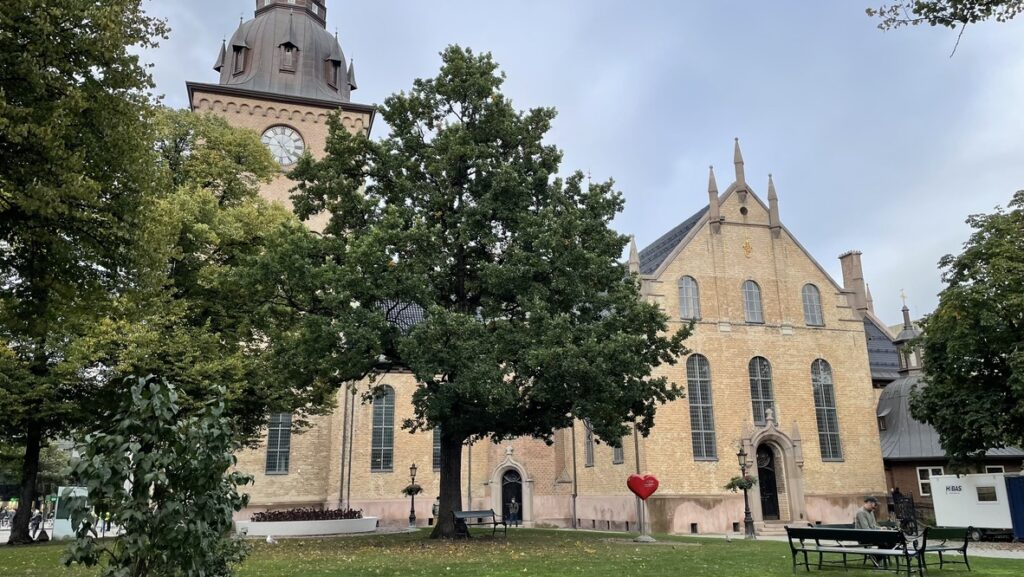
Eventually the bus came, and I boarded and watched the window. We passed a record store where I had bought some Kaizers Orchestra CDs. If I was smarter I would have planned this trip so I could see them live, but ironically they were touring internationally at the time. The bus continued until eventually the surroundings became familiar again. The city cathedral, a McDonald’s I resisted eating at, the Pokémon store with a statue of Saint Olaf above the entrance. I loved that about this city, the old and the new meeting, the sense of creation in an ancient place.
I found a laundromat.
I need you to understand that this was an accomplishment.
The Oslo tourism website makes a point of warning travelers that laundromats are rare. Nearly every residence and hotel in the city has their own laundry machines. The laundromats could be counted on one hand and exclusively served itinerant tourists.
I confirmed this to be true, as the only other people I saw in my time in that cramped room were a French-speaking couple. But the machines in my hotel were broken, or maybe I just couldn’t figure out how they worked. Besides, this place seemed more sanitary anyway. The French couple left as soon as their washer was locked. Stuck a tram ride away from my hotel, I idly sat and watched the passersby outside. Foot traffic was sparse. It was raining again. Tiny rivers flowed between the cobblestones. On my last full day, I had seen more rainy days in Oslo than sunny ones. I wished I could have seen it in a better mood. Someday I will.