From the top of the ship I watched the village of Gudvangen slip into the distance. I feel unsure using even the word “village,” because “village” implies a resident population. The Gudvangen that I saw existed solely to accommodate this vessel and its passengers. Here’s a complete account of my time in Gudvangen: I bought a croissant and coffee from the bakery, ate them, bought a knit cap from the gift shop (which sold the exact same troll figures I saw in Voss), and boarded the ship. If I had more time I could have visited the “Viking Village” and its cluster of sod-roofed buildings. It struck me as the Norwegian equivalent of a tourist trap in this Norwegian equivalent of a highway rest stop. But leaving an American rest stop leads to just more highway, flat pavement slicing through the earth. Beyond the bakery the shadowed dale wound all the way back to Voss. Behind me was the fjord.
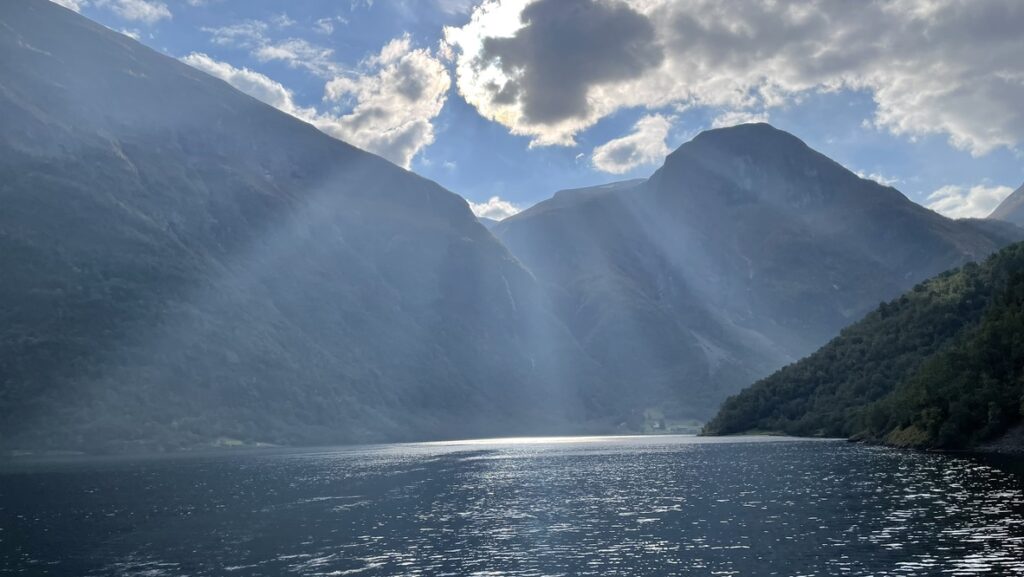
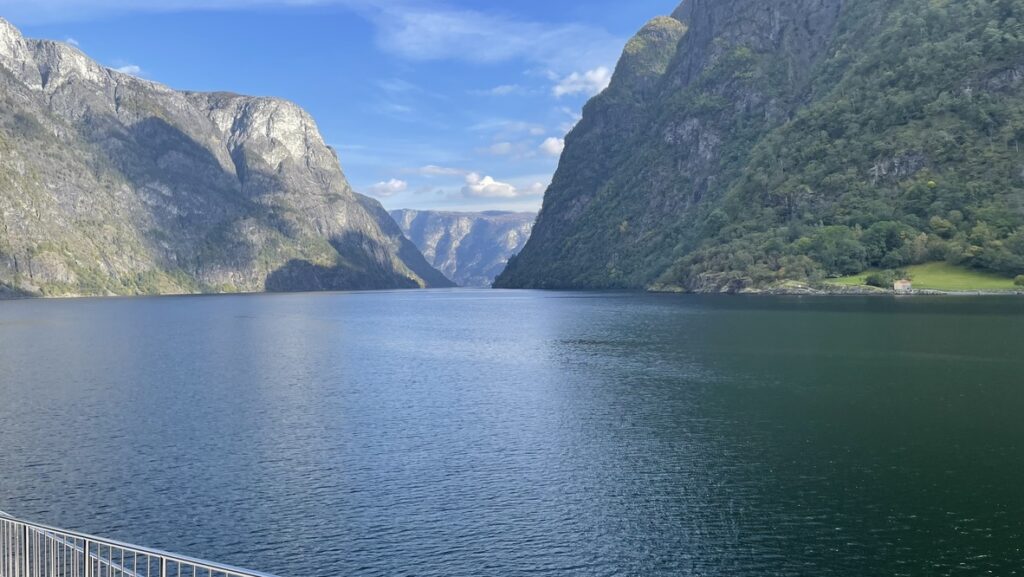
Nærøyfjord is one of Norway’s most famous and most popular fjords—I had plenty of company on board. Craning my head I struggled to comprehend the severe heights of the surrounding mountains even with them directly in front of me. I tried to imagine the glaciers carving this tunnel over the millennia and felt how a squirrel must feel trying to understand why a car moves. Peppered along the walls of the fjord were dozens upon dozens of waterfalls. Some leapt out horizontally, posing for our cameras. Others stayed in the shadows and carved new paths of their own in the rock. Dwarfed by their environment they looked like kitchen taps, like the stone walls held back a flood and the dam was about to break. Overhead was a bright blue sky. Occasionally the sun filtered through clouds into visible rays like a spotlight highlighting its favorite parts.
When the boat picked up speed I put on my knit cap, blue with a Norwegian flag emblem, grateful that I had talked myself into buying it here instead of waiting. The Nordic temperature felt more real at this speed. The cold was easy to forget when standing still in the sun. Now it chewed at my nose and ears. I still relished it.
The cold was also my best indication of our speed, as the boat seemed to sit still next to the impossible size of the environment. This was the Future of the Fjords, a fully electric sightseeing ship with a fully accessible exterior. Seemed more like the Present of the Fjords to me. I staked my claim on a point at the top for the full panoramic view. Much of the Chinese tour group I inadvertently joined followed me to the roof, while the rest took shelter either inside or aft, where the ship could block the wind.
Off the port side were a couple clusters of buildings. I wondered about the people who lived here. Farmers, surely. The sheep population must outnumber the humans here. Against the wall of a white house I thought I saw a flash of color. It was a person, jogging on a trail running along the fjord and keeping good pace with our ship. He wore dark shorts and no shirt. Even from this distance I could sense the sweat dripping onto his shoulders like he was immune to the cold. He must live here. Is this jog part of his morning routine? I failed to imagine how anything so majestic could be routine.
We reached the halfway point of the cruise, where we turned around a craggy corner and floated back inland. My feet hurt.
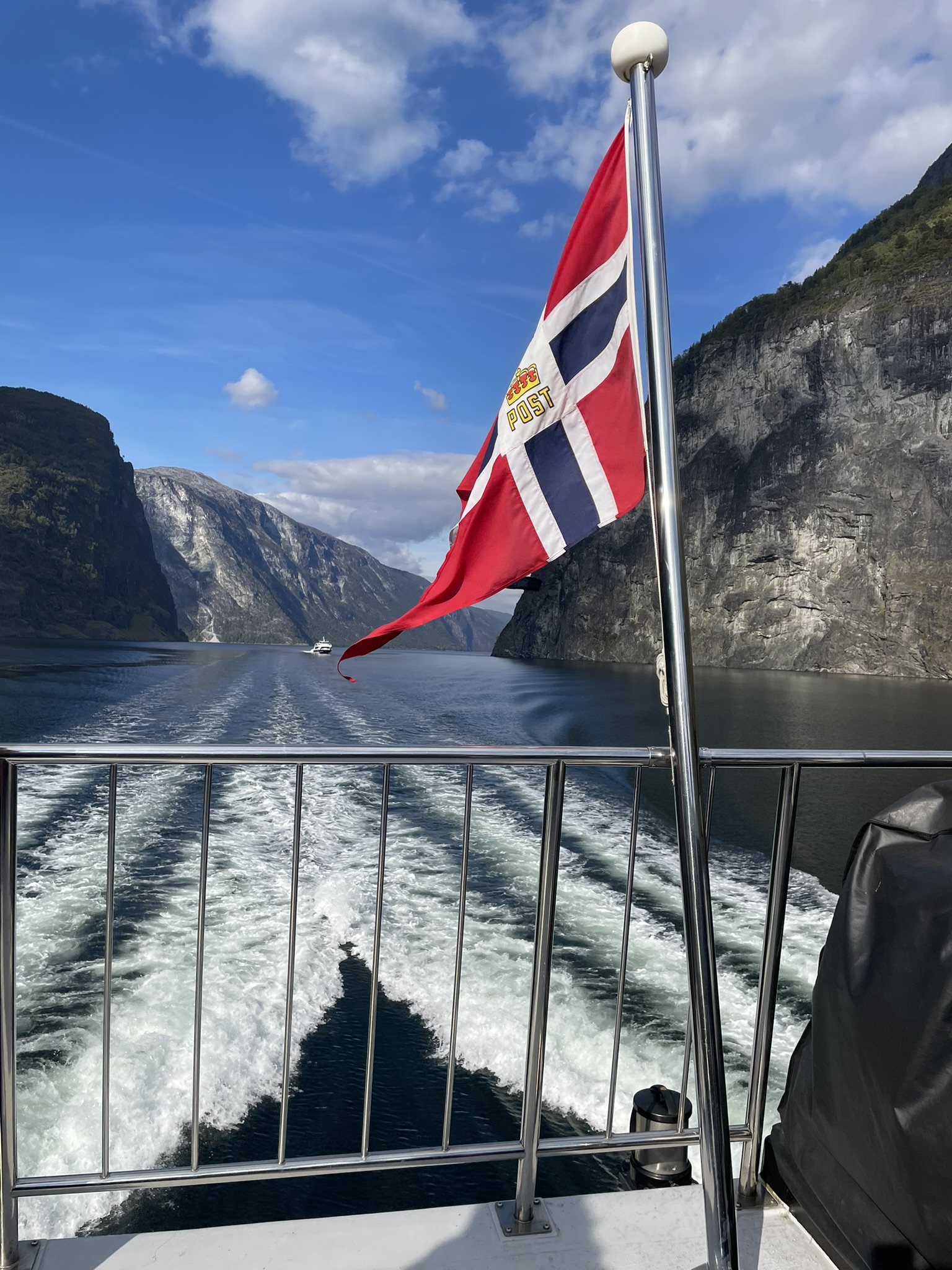
We briefly stopped at a port before continuing to our destination of Flåm. A few passengers departed, so I quickly claimed a seat left behind inside. I hadn’t realized how cold my face was until I felt it thaw. Large windows surrounded both decks. I sat near the stern on the lower one, watching as the vistas we passed floated over our wake, framed by the Norwegian naval flag on the starboard side, then slid out of sight.
At the other end of my long bench was a family of four. I strained to guess what language they were speaking and decided on something Eastern European. The oldest daughter stared into her phone, performing disinterest in her family and by extension the journey itself. The other child was about two years old, maybe younger, definitely too young to understand what was happening despite the mother’s best effort. “Look at that!” she probably said, pointing out the window, and the child’s gaze followed her finger with precocious intent. It reminded me of my cousin who as a toddler flew with my aunt to visit us from New York once or twice a year. He had no sense of the distance of that trip. To him, Florida was just another region of New York1 that you took a weird special car to get to. This family’s baby will think the same way. Here we are in one of the most beautiful views Earth has to offer. To this kid, that’s just what the world is like.
The train out of Flåm has a reputation as the most beautiful train ride in the world.
Sorry, I completely skipped over Flåm itself. Flåm sucks. Flåm is a mall of overpriced souvenir stores next to a pile-up of food trucks that charge whatever you have left in your wallet. I couldn’t wait to get out of it physically and can’t wait to get out of it narratively.
The train out of Flåm has a reputation as the most beautiful train ride in the world. I haven’t ridden enough trains to confirm that with confidence, but until Kubla Khan builds a train through Xanadu, I easily believe it.
The line is the steepest of its kind in Europe. Discard images of the Little Engine That Could chugging up a roller coaster ascent; you can’t really feel the steepness from inside, except from its length. It spirals unnaturally up and down the mountains. This was once necessary for freight during Flåm’s brief life as a shipping hub. A cramped two-room museum in Flåm will tell you all about it, if you like. Today it exclusively serves tourists like me and my Chinese comrades. I sat in the same booth as two of them, a young man and his wife. His name was Yang and he spoke barely more English than I spoke Mandarin. We entertained each other with our attempts before turning our attentions to the window.
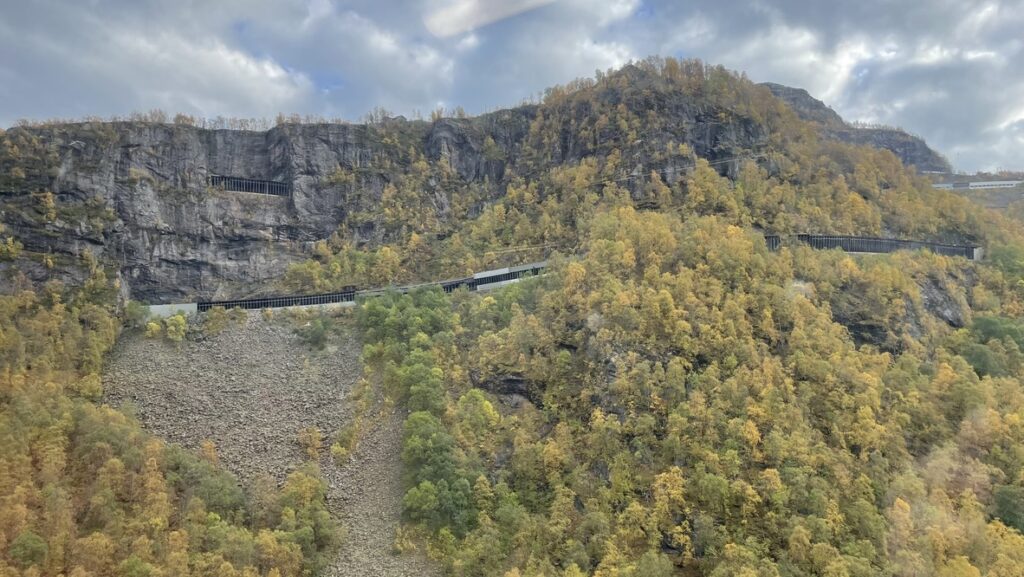
The train ambled through a valley coated with yellow-green trees. Below us a river raced white along the train tracks. Because of the spiraling design of the tracks, we had several presentations of each view, a little higher or lower every time. I took the best pictures I could through the window.
A voice on the train speakers announced, first in English and then Norwegian, that we would be making a five-minute stop to appreciate a waterfall. This struck me as odd but not suspicious for a train full of tourists. We stopped and I exited with the majority of the passengers. I noticed that some stayed behind. Maybe they’d seen it before.
The waterfall was not impressive, running at the rate of a garden hose filling a pool. I took some photos out of obligation. Then I heard the music. A thumping beat, ump ump ump, was joined by a medieval-sounding instrument. And then a voice. I suddenly noticed I was the only person still facing the waterfall. On the mountainside was a woman, barely visible but for her flowing red dress, dancing for her captive audience. I gathered this was retelling some sort of folk tale. She spun, the music faded, and she vanished behind a rock.
We shuffled back on the train, passing again the passengers who hadn’t moved from their seats. Yes, they had definitely seen that before. Next time I’ll be one of them. I went back to my window and stared at the world passing outside, turning browner as we got closer to the end of the Flåm line. I checked my ticket. I was transferring to the Bergen line, but it would be about an hour wait at Myrdal station. It was dinner time. I hoped they’d at least have a cafe. My thoughts went back to the woman in red: how many times a day she danced, whether she enjoyed it. Did she have pride in what she did, in her homeland?
Most of the passengers, including my Chinese travel companions, transferred to a train going west, presumably back to Bergen. I boarded one heading east towards the capital. No one was on this train for sightseeing. I shared a car with only two other men. One slept, the other stared intently at his laptop, hard at work. I gazed out the window again.
It grew late. Yellow leaves became gray gravel and stone and even snow as if the setting sun were taking the color with it. I was looking forward to staying in the same city for more than one night.
I took notice again of the buildings we passed, squat structures erected at the edges of lakes barely visible in the twilight. One even had a sod roof. There were no sheep in sight, and this rocky landscape certainly couldn’t be farmland. Who lived here, then? Would they let me visit? Or do they live all the way out here precisely because there are no visitors? The train sped on, and the buildings became less lonely. Grocery stores, apartment buildings, suburbs.
The train announced, first in Norwegian and then English, that there was a delay. It would be another midnight arrival for me. I closed my eyes and rested.
- Hard to dispute. ↩︎